
The League Bet Expert Playbook: Data-Driven Betting on English Football
 Available in US
Where the odds get smarter.
Start Reading
Eight years ago I walked out of a betting shop in Camden with a £40 winning slip and the wrong lesson. I'd backed a treble on three Saturday Premier League home favourites – the kind of slip that gets framed by people who've stopped thinking. Two of those bets were terrible. I just got lucky on the third. It took me another two seasons of losing money, with a notebook to prove it, before I understood that being right about a result and being right about the price are completely different jobs. Most punters never make that distinction. Experts live and die by it.
This is the playbook I wish someone had handed me back then. Not a list of tomorrow's nailed-on bankers. Not a tour of welcome bonuses. A working framework for how a serious bettor reads English football – the Premier League, the Championship, League One and Two, the cup nights at Wembley and the grim midweek trips to Burton-on-Trent. We are going to talk about expected goals, pressing intensity, what the £150 financial risk check actually triggers, why eight Premier League clubs are about to lose roughly £60 million a year in shirt sponsorship, and how Sportradar's algorithms quietly flagged 618 suspicious football matches in 2025.
Who I am, briefly. Premier League betting analyst, eight years inside the English football markets. My day is xG model outputs, line shopping, and arguing with myself about whether a quarter-line Asian handicap is sharper than the standard 1X2. I'm not selling tips. I'm showing you how the work gets done.
Football is the biggest betting market in the United Kingdom and it isn't close. Remote football betting alone produced £1.3 billion in gross gambling yield for the year ending March 2025, per the Gambling Commission's annual industry statistics, and six percent of UK adults placed live in-play football bets in the first quarter of that year. When something that large meets edges as small as the ones available in modern markets, the only way to extract value is process. Everything that follows is process.
The expert's shortcut to this playbook
- Being a league bet expert in 2026 means running an xG-led process, line shopping across operators, and respecting variance. It is not about picking winners; it is about beating the closing price.
- The two markets that pay the rent are the Premier League and the EFL Championship – the latter literally the richest single fixture in world football, with the play-off final worth a minimum £205 million to the winner.
- UK rules are changing fast: Remote Gaming Duty rises from 21 percent to 40 percent in April 2026, a new 25 percent online General Betting Duty arrives in April 2027, and the £150 net-loss financial risk check has been live since February 2025.
- Front-of-shirt gambling sponsorship leaves Premier League kits at the end of 2025/26, removing roughly £60 million a year in club income and reshaping how operators reach the average bettor.
- Long-term edge comes from three habits: pricing your own true number before looking at the market, tracking yield not strike rate, and staking small enough that a 12-game losing streak feels boring rather than terminal.
Contents
- What separates a league bet expert from a hopeful punter
- The English football betting landscape in numbers
- The Premier League as a betting market
- The EFL Championship and the richest game on earth
- The analyst's data stack: xG, PPDA and Poisson together
- The core markets and where each one earns its keep
- UK regulation 2026 to 2027 and what it actually changes
- Integrity, suspicious matches and why it matters to your slip
- Building a weekly betting routine that survives a bad month
- Tools, data feeds and the shortlist worth your time
- Questions I get asked every week
What separates a league bet expert from a hopeful punter

I had a coffee last winter with a friend who runs trading at a mid-sized sportsbook. He told me something I've quoted to every bettor who'll listen: "Your customers don't lose because they're stupid. They lose because they have an opinion and we have a price." That sentence is the whole job. An expert doesn't pretend to know more about football than anyone else in the pub. An expert knows when the price disagrees with the probability.
Andrew Rhodes, who runs the Gambling Commission, has called the regulator's own survey a key building block of the evidence base that helps the industry understand both gambling behaviour and its potential consequences. That frame – evidence and behaviour – maps neatly onto how a serious bettor should think. Just turn it inwards, onto your own slips and the market you face.
An expert is defined by three habits casual punters never sustain: pricing the match before checking the market, keeping a written record of every wager, and treating a single losing weekend as a sample of one rather than a verdict.
Let me get specific about what the work actually looks like. On a normal Saturday in the Premier League I'll open my model output around Wednesday – rolling xG and xGA over the last ten matches, with home/away splits, set-piece share, and an injury column that's basically an English Premier League rumour mill on a spreadsheet. I generate a fair price for each market I care about: 1X2, Asian handicap on the quarter line, total goals, both teams to score, and four player props per game. Then I look at the market. If my number says 1.95 and the best available price is 2.10, I have a bet. If the best price is 1.80, I haven't lost anything – I've correctly avoided a bad wager. Discipline is mostly composed of bets you didn't make.
Closing line value – the gap between the price you took and the price the market settles on just before kick-off. Sharp bettors care about closing line value far more than the result of any individual bet, because the closing price is the most accurate forecast available and beating it is the cleanest signal that you have an edge.
The UK betting population is also more concentrated than punters realise. Fifteen percent of British men placed sports bets in the first quarter of 2025 against four percent of women, on the Gambling Commission's own survey numbers. The share within that group who treat betting as a structured pursuit – with a bankroll, a written process and a yield target – is small. Becoming one of those people doesn't require talent. It requires the unglamorous habit of saying "no bet" out loud on most Tuesdays.
Patience with horror weeks is the other half. I keep a single line at the top of my betting log: "12 losers in a row at 60 percent equates to roughly one season per career." When you've eaten an 0-and-9 weekend the brain wants to do something – upstake, chase, switch markets, abandon the model. Experts have a written protocol. Casuals improvise. That's the whole gap.
The English football betting landscape in numbers
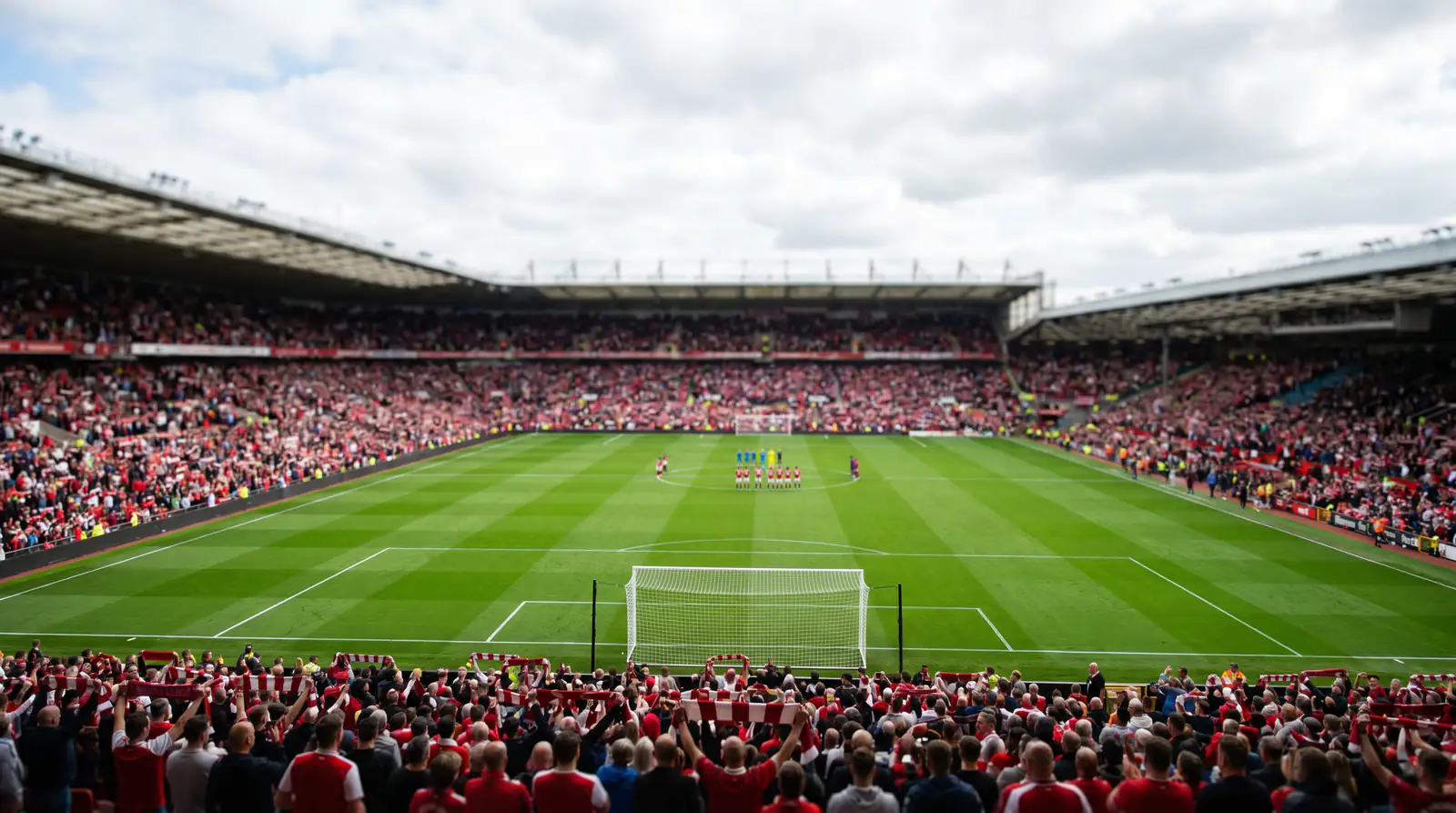
Here's a question I ask new bettors: how many real-money online bets do you think get placed in the UK every month? Most guesses come in around five million. The actual number, on Statista's gambling tracker, is closer to 290 million – the population of Indonesia, betting every thirty days, from kitchens and commutes and pub gardens across Britain. The scale shapes everything about how the markets behave.
£4.5bn
UK industry gross gambling yield, Q4 2025 – up 2.27 percent year on year (UK Gambling Commission).
£1.3bn
Remote football betting GGY, year to March 2025 – the single biggest sports market.
290m
Online real-money bets placed in the UK each month, per Statista.
24.4m
Active accounts at quarter-end for remote casino, betting and bingo operators, FY2024/25.
Within that £4.5 billion quarter – the Q4 2025 industry gross gambling yield reported by the Gambling Commission – remote betting is the dominant engine. The annual remote betting take for the year to March 2025 was £2.6 billion, and football is half of it. Pull back one year, to the corrected July 2025 statistics covering April 2023 to March 2024, and you see horse racing's GGY at £771.1 million next to football at £1.1 billion. Football has been pulling away from racing for most of a decade.
Two more facts every English-football bettor should internalise. First, 39 percent of UK adults gambled online in some form during a four-week window in the third 2025 wave of the Gambling Survey – dropping to 16 percent if you exclude lottery draws. Second, 95 percent of UK online gambling happens from home, and 76 percent of 18 to 24 year-olds bet from a mobile phone. The market lives on a phone screen, in a living room, late on a Friday after the kids are in bed. That isn't a moral observation – it explains why in-play is the fastest-growing product and why bankroll discipline is harder than it used to be.
Six percent of all UK adults bet on live football during Q1 2025 – the single most popular form of in-play wagering in the country. Live football is the engine room of the modern UK sportsbook.
The participation gap by gender is worth pausing on. Fifteen percent of men versus four percent of women placed a sports bet in Q1 2025, with the gap widening by the third quarterly wave. The audience is overwhelmingly male, overwhelmingly mobile, and increasingly young – with implications for how the financial risk checks bite and for who sees gambling advertising once the front-of-shirt ban takes effect. When we look at the broadcast money behind the Premier League next, that pyramid will make a lot more sense.
The Premier League as a betting market
The first Premier League weekend of every season I do something slightly ridiculous. I open a new spreadsheet, type "fresh start" at the top, and look at my closing-line value from the previous campaign. Every time, the lesson is the same: gameweek one is wider, gameweek five tighter, and by January the closing prices on the top six are basically a wall. The Premier League is the sharpest football market in the world. That's what £12.25 billion of combined commercial and broadcast revenue for the 2025 to 2028 cycle – a seventeen percent jump on the prior deal – buys the traders on the other side of your slip.
For the next three seasons, Premier League revenue splits roughly in half between two pipes. The domestic broadcast deal covering 2025/26 through 2028/29 is worth £6.7 billion, or £1.675 billion a year, with Sky Sports taking a record share of around 215 live matches per season. International rights for the same window add another £6.5 billion, averaging £2.1 billion annually. Inside that money sit the trading floors that price your Saturday three o'clock kick-offs.
One number that should bother every operator and broadcaster alike: average domestic Premier League viewership across the two main UK rights-holders fell 14 percent year on year in 2024/25, to 2.52 million viewers per match. The product is still vast but the audience is thinning at the same moment the rights bill is climbing. That tension will push back into the betting product – richer in-play, more aggressive promotions, more bet-builder marketing.
Premier League edge lives in narrow corners: post-international breaks, midweek congestion, lineup news in the last hour before kick-off, and the player-prop board where bookmaker models can't keep up with rotation. The 1X2 line on top-six fixtures is almost always efficient.
Outright markets deserve a sentence of their own. The title race almost always falls to a club priced inside the top three in pre-season, but top-four and top-six markets are routinely mispriced through August because the public over-anchors on last season's table. Strong models find genuine value in secondary outright lines every July and early August. By October that window is closed.
Worked example – reading a Premier League fair price.
Suppose your xG-led model gives Home 51 percent, Draw 26 percent, Away 23 percent. Implied fair odds: Home 1.96, Draw 3.85, Away 4.35. If a UK book offers Home 1.90, Draw 3.70, Away 4.50, the only side with positive expected value is the away win – a fair-odds gap of about 3.4 percent. You'd back that line or skip the market. The home favourite is the bet your friends will brag about; the away outsider is the bet that pays your rent over a season.
Player props are where casual money concentrates and where serious bettors find the most consistent edge. Opta's shot-quality model uses up to twenty contextual factors per shot when estimating xG and trains on roughly one million historical shots. The bookmaker's "X player to have 2+ shots on target" engine does something similar but coarser. When you have a directional read on a starting eleven and the book is still pricing the previous lineup at 5pm Saturday, the gap is real – and it closes quickly. For the deep treatment of EPL-specific markets, the strategic frame for outrights, props and bet-builders is the entire focus of the Premier League betting expert guide.
The EFL Championship and the richest game on earth

There's a stat I roll out at every betting conference because it never fails to land. The Championship play-off final at Wembley is the single most lucrative ninety minutes in world football. The 2026 winner banks a minimum of £205 million in first-season Premier League revenue – Deloitte's modelling, reported by Sportico – and up to roughly $490 million if they survive the drop. By any measure, that's a more financially consequential match than the Champions League final. Now ask yourself: how many bettors actually price that fixture differently because of what's at stake? Almost none. That gap between economic gravity and market behaviour is where Championship edge lives.
Step back and look at the league. Championship clubs generated £958 million in revenue across 2023/24, up 28 percent year on year, with matchday income reaching a record £210 million in Deloitte's Annual Review of Football Finance 2025. Average attendance was 22,845 across 12.7 million total spectators – making the EFL Championship the second best-attended league in Europe. This is not a "second tier" in any normal sense. It's a near-Premier League economy operating without near-Premier League data infrastructure, which is precisely why it stays exploitable.
The Championship's defining financial feature is owner injection. Twelve clubs accepted £554 million in equity-style funding from owners in 2023/24, with Birmingham, Leeds and Middlesbrough alone responsible for 70 percent of the total. That money buys squads. The market often hasn't repriced.
The most recent completed season shows the pattern. The 2025/26 Championship ended with a record 1,438 goals across 552 matches – 2.61 per game – with Coventry City crowned champions. Žan Vipotnik of Swansea City finished top scorer on 23 goals; Southampton put together the season's longest winning run at seven matches. These are baselines for next season's overs and unders. The Championship has been steadily out-scoring the Premier League in goals-per-match for three of the last four campaigns. If your model assumes EPL-style scoring rates for Championship games, your over 2.5 lines are wrong before kick-off.
Only three Championship teams that finished the regular season in third have been promoted via the play-offs in the last decade – a strike rate of 30 percent. Casual bettors over-price third-placed sides every May. The market does not.
The 2025/26 play-off final attracted controversy of a different kind. Middlesbrough were briefed about an alleged espionage operation by Southampton ahead of the tie, and the club's official statement – "we believe this sends out a clear message for the future of our game regarding sporting integrity and conduct" – was a useful reminder that the financial stakes at the bottom of the Premier League pyramid distort behaviour at the top of the second tier. Whatever you think of the specific incident, it sat squarely inside the £205 million economic logic.
The wider European context matters here. The European football market reached a record €38 billion in 2023/24, up eight percent year on year, with the "big five" collectively breaching €20 billion for the first time. The Championship sits outside that big-five aristocracy but generates more matchday revenue than several leagues inside it – huge sporting and financial consequence, broad public engagement, and a fraction of the data sophistication around La Liga or Bundesliga matches.
Where casual punters get burned is by treating the Championship like a quieter Premier League. It isn't. Data is patchier, squad rotation more chaotic, owner ambition cycles in two-year waves, home advantage stronger because of crowd density and Tuesday-night travel. Those asymmetries reward the model-driven bettor willing to do the legwork. For the operational toolkit – which sides to fade out of the international break, how parachute payments distort the autumn promotion market, where the play-off final goalscorer line is regularly mispriced – the full treatment lives in the EFL Championship betting expert guide.
From the leagues themselves to the data we use to price them.
The analyst's data stack: xG, PPDA and Poisson together

I keep three numbers on the index card stuck to my monitor: xG, PPDA, and Poisson lambda. They sound like an esoteric club of stat-speak, and at one point I treated them that way. Then I ran a simple test: priced every Premier League weekend for a season using nothing but xG-based fair prices and compared my closing-line value to the market. My number alone beat the closing price on about 53 percent of bets. Adding pressing intensity and a Poisson goal-distribution adjustment pulled that closer to 56 percent. Each layer added something specific.
Expected goals (xG) – the probability a given shot becomes a goal, based on shot location, type, body part, defensive pressure and the assist that created it. A team's match xG is the sum of those shot probabilities. Aggregated over six to ten matches, xG is a more honest forecast of underlying attacking quality than the actual scoreline.
Start with xG because everything else hangs off it. Opta's contextual model uses up to 20 factors per shot – assist type, goalkeeper position, body part – and the underlying model is trained on roughly one million historical shots from professional football. That training set is why Opta's xG is robust at the top of the pyramid. The same model is less stable in League One because it has seen fewer of those exact patterns, but it's still meaningful.
The independent academic literature has finally caught up with what sharp bettors knew empirically. Sascha Wilkens, writing in The Journal of Sports Analytics in 2026, showed that a simple xG-based forecast produced a roughly 10 percent return on investment against average market odds across the Bundesliga, rising to almost 15 percent when betting into best-available prices. In Wilkens' own framing, "while xG-based forecasts are slightly less well calibrated than market odds, they capture certain signals that translate into consistent, albeit modest, profitability." The word "modest" is doing important work – we are not talking about doubling your bankroll in a month. We're talking about a real, durable edge that compounds if you don't blow it up with stake-sizing mistakes.
Worked example – rolling xG into a fair line.
Home side rolling ten-match xG of 17.4 against an opponent xGA of 11.8 over the same window.
Average the home attack number with the opponent's defensive concession to produce a fixture-specific expected goals: (17.4/10 + 11.8/10) / 2 = 1.46 expected home goals. Do the symmetric calculation for the away side – suppose this yields 1.12.
Feed both expectancies into a Poisson distribution to produce probability of each scoreline, then aggregate to 1X2 and totals. If the implied fair home win price is 1.92 and the market offers 2.10, you have a 9 percent edge on the favourite – the kind of gap that matters over a 200-bet season.
Once you have xG as a baseline, PPDA – passes per defensive action – tells you something xG can't. It measures how many opposition passes a team allows in the attacking two-thirds before making a defensive intervention. Low PPDA means an intense, high press. High PPDA means a passive, deep block. The signal drives goal-volume variance: high-press matches between two coordinated sides produce more shots, transitions and goals; two low-press sides produce dour stalemates. If your over 2.5 line is priced off historical scoring rate alone, you're missing the regime-shift information PPDA contains.
The third leg, Poisson, lets you turn an expected-goals number into a full distribution of scorelines. It assumes goals are independent and the rate is roughly stable across a match – two assumptions that are almost true and not quite true. Modern adjustments such as Dixon-Coles correct for the under-prediction of 0-0 and 1-1 scorelines that pure Poisson generates. If you only use one model, use a corrected Poisson with xG-derived lambdas.
The xG provider landscape is small. Understat is free, web-based, and excellent for the big five. Opta (via Stats Perform) is paid, enterprise-grade, and the underlying feed every major bookmaker uses. FBref carries the StatsBomb feed for free and offers the best free coverage of the Championship and League One. A 2024 comparative analysis of five major European leagues from 2017/18 through 2023/24 found Understat produced smaller prediction errors than Opta in the Bundesliga, Premier League and Serie A, while Opta was more stable in La Liga and Ligue 1. Different providers calibrate slightly differently and the smart move is to combine. For the deep dive on how to weight xG inputs, when to override the model and where it falls down in EFL competitions, see the expected goals football betting guide.
The core markets and where each one earns its keep

A friend asked me last month which market was "the best" for English football and I gave him the only honest answer: none of them, all of them, depending on the fixture. The market that pays you on a Liverpool home banker is not the market that pays you on a Tuesday-night League One trip to Stevenage. An expert keeps a stable of perhaps six core markets in regular rotation and treats each one as a different tool.
The expert's core markets, side by side
| Market | Strength | Weakness |
|---|---|---|
| 1X2 match result | Highest liquidity, easiest to line-shop | Highest overround on tight matches |
| Asian handicap | Cleanest market on mismatches, lowest margin | Quarter-line settlement confuses casuals |
| Total goals over/under | Reacts slowly to lineup news | Weather-sensitive in autumn and winter |
| Both teams to score | Easy to read with shot-volume data | Higher margin than alternative totals |
| Bet builder | High public engagement, customisable | Correlation models overprice combinations |
| Player props | Slowest to react to lineup changes | Stake limits drop quickly when you win |
The Asian handicap deserves attention beyond its share of UK betting volume. It removes the draw and replaces it with a goal start, which means the bookmaker can price two outcomes instead of three – overround drops by roughly two percentage points compared with the equivalent 1X2 line. On heavy favourites against relegation-bound sides, the AH market is the sharpest line on the entire board. If you're new to it, the quarter-line settlement (push on half the stake, win on the other) is the only obstacle and after watching two of them settle you'll never go back.
Bet builders are the market I'm most ambivalent about. Premier League weekends are now drowning in same-game multi marketing, and the underlying maths is fundamentally hostile to the punter. When a book combines "home win", "over 2.5 goals" and "Player X to score", it prices the correlations between those outcomes – in practice, the implied margin on a five-leg builder typically lands between 15 and 25 percent. That's the same overround as a hand-pulled accumulator from 1992. New product, old maths.
Do
- Treat 1X2 and Asian handicap as substitutes – take whichever has the lower overround on the side you want.
- Price total goals from rolling xG totals, not from historical goals scored.
- Compare BTTS against the alternative totals market – sometimes "over 1.5 goals" pays better for the same idea.
- Build your own fair price before clicking on the bet-builder feature.
Don't
- Mix outright and individual-match bets in the same staking framework.
- Add a fifth leg to a bet builder because the price looks nice.
- Bet first goalscorer on a player you wouldn't have backed for anytime scorer.
- Take cash-out unless you're hedging an outright at extreme odds.
Outright markets – title, top four, relegation, top scorer – are the slow-cooking corner of the calendar. Higher overround than match markets, capital tied up for months, so most experts allocate no more than 15 to 20 percent of seasonal bankroll to them. They offer asymmetric edge in the first three matchdays before the market has digested injury patterns and lineup choices. Bet outrights in July and August or wait until late February when prices collapse into near-certainty.
Player props are the quietest profit centre most experts run. Opta-style player data is heavy enough that bookmakers have stopped manually pricing every line and increasingly use model output, which means the model errors are duplicated across operators. If you have a directional read – the wing-back is starting, the striker has 70 percent of penalty duty since the new manager arrived – you'll find the same mispriced line at three or four books at once. The catch is that operators limit stake size on prop winners faster than on any other market. Expect £200 stakes to become £40 stakes within a month of consistent profit.
UK regulation 2026 to 2027 and what it actually changes

If you're betting on English football in 2026, the regulatory ground under your feet has moved more in eighteen months than in the previous decade. Most punters I speak with do not know what changed, do not know what is about to change, and do not realise how it will reshape odds, promotions and account behaviour. Four pieces matter.
First, tax. From 1 April 2026 the UK's Remote Gaming Duty rises from 21 percent to 40 percent – the most significant single change to gambling duty in a generation, in the OBR's Autumn Budget 2025 framing. RGD covers remote casino and gaming products, not sports betting directly, but it affects every multi-product operator because casino margin subsidises sports promotion budgets. Expect tighter welcome offers, slower free-bet returns and stingier acca insurance. The change funds the Exchequer rather than the punter.
Second, a new tax specifically aimed at online sports betting. From 1 April 2027 the General Betting Duty for online sports betting rises from 15 percent to 25 percent. UK horse racing stays on 15 percent – an explicit political concession to the racing industry. For football bettors, the 25 percent figure is the relevant one. The Treasury expects total betting and gaming duties to deliver £4 billion in 2025/26, equivalent to 0.3 percent of all government receipts.
The combined effect of the 2026 RGD hike and the 2027 GBD increase is the single largest tax shock the UK online betting industry has ever absorbed. As one industry analysis put it, "operators that diversify attract larger audience segments, minimize exposure to sudden regulatory changes and achieve higher profit margins." That's industry-speak for: small operators will exit, and the survivors will pass costs along.
Third, financial risk checks. Since February 2025, the threshold that triggers a financial vulnerability assessment has been set at a net loss of £150 over a rolling thirty-day window. An open-banking analysis in Public Health, by Bristol and UCL researchers, found almost 25 percent of gamblers cross the £150 threshold and account for approximately 92 percent of all gambling expenditure in the sample. Most of the money is being spent by the people the checks were designed to find.
The industry response has been loud and the regulator's response has been louder. Grainne Hurst, who runs the Betting and Gaming Council, has been blunt that "forcing punters to hand over bank statements isn't 'frictionless', it's intrusive and will drive customers to the illegal market, where there are no safeguards at all." Her broader concern is the experience after a flag – "punters care about outcomes, not process. If an assessment leads to intrusive follow-up questions, requests for personal financial documents and account restrictions, then the customer experience will be severely disrupted." On the regulator's side, Tim Miller has been just as firm that the data collected through the checks "can only be used for the purposes of helping to protect consumers. It cannot be used for commercial purposes." Both quotes matter. Both sides will shape how the regime evolves.
Fourth, advertising. By the end of the 2025/26 season, Premier League clubs must withdraw front-of-shirt gambling sponsorship – the first sports league in the UK to do so voluntarily. In the league's own announcement, clubs "agreed to withdraw gambling sponsorship from the front of clubs' matchday shirts, becoming the first sports league in the UK to take such a measure voluntarily." Eight Premier League clubs had front-of-shirt gambling sponsorships worth roughly £60 million a year before the ban took effect. That money won't disappear; it will redistribute to sleeve sponsorship, stadium signage, digital and broadcast inventory.
For the punter, the regulatory year ahead means three concrete shifts: lower-value promotions, more verification friction at the £150 trigger point, and fewer gambling logos in the camera shots that frame every Premier League broadcast.
The Gambling Commission issued 741 cease and desist warnings to advertisers and illegal operators in 2025/26, per Tim Miller at the Ethical Gambling Forum. The granular detail – which dates trigger which rules, how RGD interacts with operator margin, what the open-banking pilot looked like – sits inside the UK gambling regulation 2026 guide.
Integrity, suspicious matches and why it matters to your slip

The single most uncomfortable conversation in modern sports betting is the one about match-fixing. Punters either dismiss it as conspiracy or treat it as background paranoia. Neither is right. In 2025, Sportradar monitored more than one million sporting events across 70 sports and flagged 1,116 as suspicious – a one percent decrease year on year. Of those, 618 were football. Football is the suspicious-matches market leader by a wide margin and nothing about that is likely to change.
Sportradar's UFDS – Universal Fraud Detection System – flagged 56 percent more suspicious matches via its AI layer in 2025 than the year before. The technology is getting better at catching fixers in real time, which is the only reason the topline number isn't worse.
Andreas Krannich, who heads integrity services at Sportradar, framed the 2025 numbers with appropriate caution: "the relative stabilisation of suspicious match numbers in 2025 is encouraging, yet it reinforces the importance of continued vigilance. Match-fixing remains an evolving threat." The blunter version, from Matthew Wein in a separate interview, is that "this is largely a cat-and-mouse game. The bad guys find an edge and then the good guys catch up."
The geographic picture is worth knowing. Europe still produces the largest absolute number of suspicious matches – it has the most football, played for the most money – but the European number actually fell by 66 cases year on year in 2025. Men's competitions accounted for 1,081 of the 2025 alerts, women's competitions for 35 (down from 51). Crowe UK and ESSA estimates put the global annual turnover of bets linked to manipulated matches at more than £103 million – a substantial sum, but a tiny fraction of overall betting volume.
What does any of this mean for your Saturday slip on Premier League over 2.5? Almost nothing, directly. English top-flight football is among the most heavily monitored, best-paid, lowest-fix-risk leagues on the planet. The risk concentrates further down the pyramid and overseas, particularly in matches with no broadcast feed. For UK bettors, the integrity ecosystem is protective infrastructure. You don't need to think about it when you're betting on Manchester City versus Arsenal. You absolutely need to know it exists when you're tempted by a third-tier Eastern European fixture at 2am.
Building a weekly betting routine that survives a bad month

The single most useful thing I ever did as a bettor was stop trying to be clever on Tuesday. My week now runs on a fixed rhythm. Monday is review. Tuesday is data refresh – rolling xG and xGA, update injury and lineup tracking. Wednesday is model output and pre-priced fair odds. Thursday is the no-bet day, deliberately. Friday is line shopping. Saturday is execution. Sunday is the same with fewer kick-offs and more coffee. The routine isn't elegant. It stops me from making the impulsive bets that used to bleed me out.
The pre-bet checklist I run before every wager
- Have I written down my own fair price before opening the bookmaker app?
- Is the implied edge after overround at least 3 percent?
- Have I line-shopped at minimum three operators?
- Does this bet pass my staking rule – between 0.5 and 1.5 percent of bankroll?
- Would I still take this bet if the result of the previous one had been different?
- Have I checked team news within the last two hours of kick-off?
- Am I betting because the price is wrong, or because I want action?
Bankroll discipline is the part no one wants to read about because it ends every interesting daydream about turning £200 into £10,000 by Christmas. The maths is simple and ungenerous. With a 3 percent edge per bet and 1 percent flat stakes, your expected weekly profit is around 0.3 percent of bankroll. Compound that across forty weeks and you've earned roughly 13 percent on the year before variance smooths it out. That's genuinely good performance – and approximately one-tenth what a fantasy of "expertise" promises. The open-banking research showing 25 percent of gamblers cross the £150 net-loss threshold and account for 92 percent of all gambling spend is, at its core, a study of bankroll indiscipline. Don't be in that 25 percent.
The psychological side matters as much as the arithmetic. The Gambling Survey for Great Britain estimates 2.7 percent of UK adults score 8 or higher on the Problem Gambling Severity Index – roughly 1.4 million people. Public Health England's estimate of around 400 gambling-related suicides in England annually is a number that should sit on every bettor's desk. Treating betting as a serious recreational activity with non-zero personal risk requires real discipline.
A sustainable routine has three pillars: a written log of every bet, a flat staking rule capped at 1.5 percent of bankroll per wager, and a 24-hour rule for any bet placed during or immediately after a losing day. The pillars are boring on purpose. Boring is what works.
Honest performance tracking is the other habit. Strike rate is misleading. A bettor hitting 55 percent at 1.80 is losing money. A bettor hitting 35 percent at 3.50 makes 22 percent yield. Track yield and ignore the rest. The complete operational framework – fair pricing, overround analysis, yield tracking, Kelly-adjusted stake sizing – sits inside the value betting football strategy guide.
Tools, data feeds and the shortlist worth your time

I get the "what's in your tech stack" question more than any other. Honest answer: less than you'd think. The infrastructure required to bet seriously on English football fits on a laptop and most of it is free. The thing that costs real time is the discipline of using it consistently.
The expert's working toolkit by category
| Category | Tool type | Why it earns its place |
|---|---|---|
| Data feed | Free xG aggregator | Rolling team and player xG for the top five leagues plus EFL |
| Lineup tracker | Club beat reporters, dedicated football news | Lineups leak roughly 90 minutes before kick-off |
| Odds comparison | Multi-operator price aggregator | Identifies the best available price across the UK market |
| Betting log | Spreadsheet, custom or off-the-shelf | Tracks yield and closing-line value market by market |
| Statistics dashboard | FBref, WhoScored or equivalent | Match-level shot maps, expected threat, pressing intensity |
The mobile-first reality of UK betting – 95 percent from home, 76 percent of 18 to 24 year-olds using a mobile phone – means your tools have to function on a phone screen at 14:50 on a Saturday while you're chasing a price that's about to move. Test every workflow on mobile before you trust it in a live gameweek. The number of bettors who set up beautiful desktop dashboards they never look at on matchday is enormous.
Two final pieces of advice on tooling. Keep your betting log somewhere that survives a laptop crash – cloud storage, a separate device, anywhere that isn't the same machine where the spreadsheet lives. And write the rules of your system in a separate document. Sounds absurd. Works. The Saturday three o'clock you most need the rules is the Saturday three o'clock you'll be most tempted to ignore them.
Questions I get asked every week
Some answers don't need a full chapter. Here are the questions that come up over and over again, with the short version of what I actually believe.
What does it mean to be a league bet expert on English football?
It means running a repeatable process: you generate your own fair price before checking the market, you stake flat or Kelly-adjusted at a small fraction of bankroll, you track yield rather than strike rate, and you accept that the work is mostly saying no. It does not mean predicting more results correctly than other people. It means systematically beating the closing price.
Which English football leagues are most popular for betting in the UK?
The Premier League is dominant by a distance, with the EFL Championship a clear second. The FA Cup and Carabao Cup peak around their later rounds. League One and Two have a smaller but loyal following. The £1.3 billion in remote football betting GGY for the year to March 2025 was overwhelmingly concentrated in the top two English tiers.
What is expected goals (xG) and why does it matter for betting?
xG is the probability that any given shot becomes a goal, based on shot location, type, body part, defensive context and the assist that created it. Aggregated across six to ten matches, it's a better forecast of underlying quality than the actual scoreline. Academic work shows simple xG-based models can produce roughly 10 percent ROI against average market odds and up to 15 percent against best-available prices. Real but modest – and only with disciplined staking.
How does the UK Gambling Commission protect bettors in 2025 and 2026?
Through licensing of all UK-facing operators, the financial risk check regime that triggers at £150 net loss over thirty rolling days, enforcement via cease and desist orders to unlicensed operators (741 issued in 2025/26), and oversight of advertising and product design. The protections are stronger than they were five years ago and tighter than in most other jurisdictions.
Can you make consistent profit betting on the Premier League?
Yes, but the realistic ceiling is far lower than marketing suggests. A disciplined model-driven bettor can target 5 to 10 percent yield over a season, with substantial month-to-month variance. Hitting that requires a sustainable edge against the closing price on at least 200 bets a year, a flat-staking rule, and the stability to keep going through losing runs. Most people who try quit inside six months.
How is bet builder different from a regular accumulator?
A regular accumulator combines outcomes from different matches, with each leg priced independently. A bet builder combines outcomes within the same match, with the bookmaker pricing correlations between legs explicitly. The implied margin on a five-leg bet builder typically runs 15 to 25 percent – higher than a comparable accumulator, because the book prices the correlations in its own favour.
Which markets give experts the biggest edge over casual punters?
Asian handicap on mismatch fixtures (lower overround), total goals priced off rolling xG (slower public reaction to lineup changes), and player props (operators rely more heavily on model output, so directional reads on lineups and roles pay). Outright markets in the first three matchdays of the season can also offer real edge. The 1X2 market on top-six matches almost never does.
