
Fractional vs Decimal Odds: A UK Bettor's Conversion Guide
 Available in US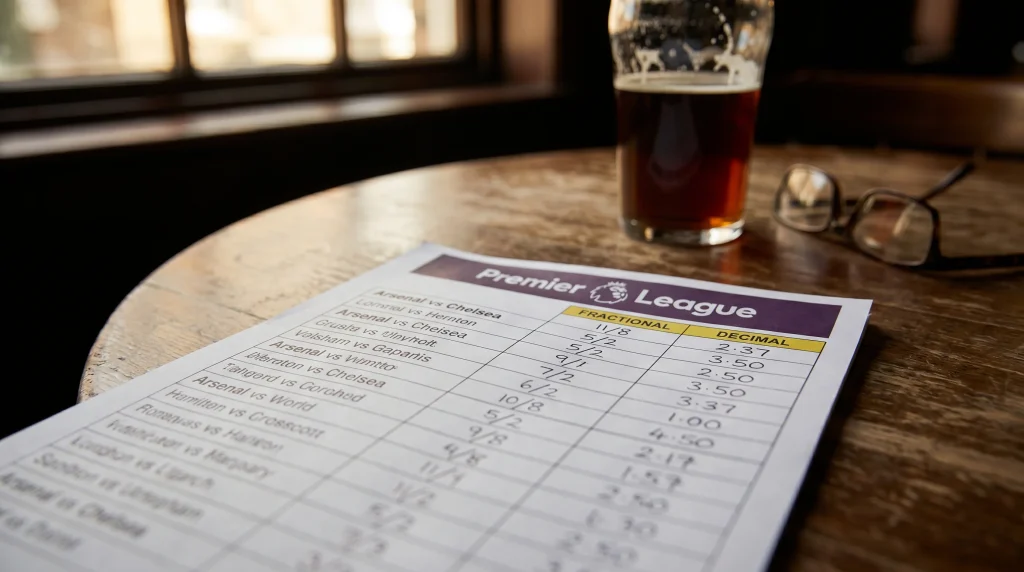
I once watched a friend stare at a betting slip for thirty seconds before quietly asking me whether 11/4 was better or worse than 3.75. He’s a smart man, runs a small business, knows his way around a spreadsheet. The format had simply tripped him up. That moment told me something I’ve seen confirmed over eight years of analysing English football markets — the fractional-decimal divide is the single most underestimated friction point for UK bettors.
Around 290 million online bets a month flow through UK sportsbooks on real-world events. The vast majority of those are placed by people who never sit down and properly learn the math behind the two formats their bookmaker shoves in front of them. They guess. They half-remember. They occasionally lose money because of it. This guide is the conversion sheet I wish someone had handed me when I started.
The Two UK Formats and Why Both Still Exist
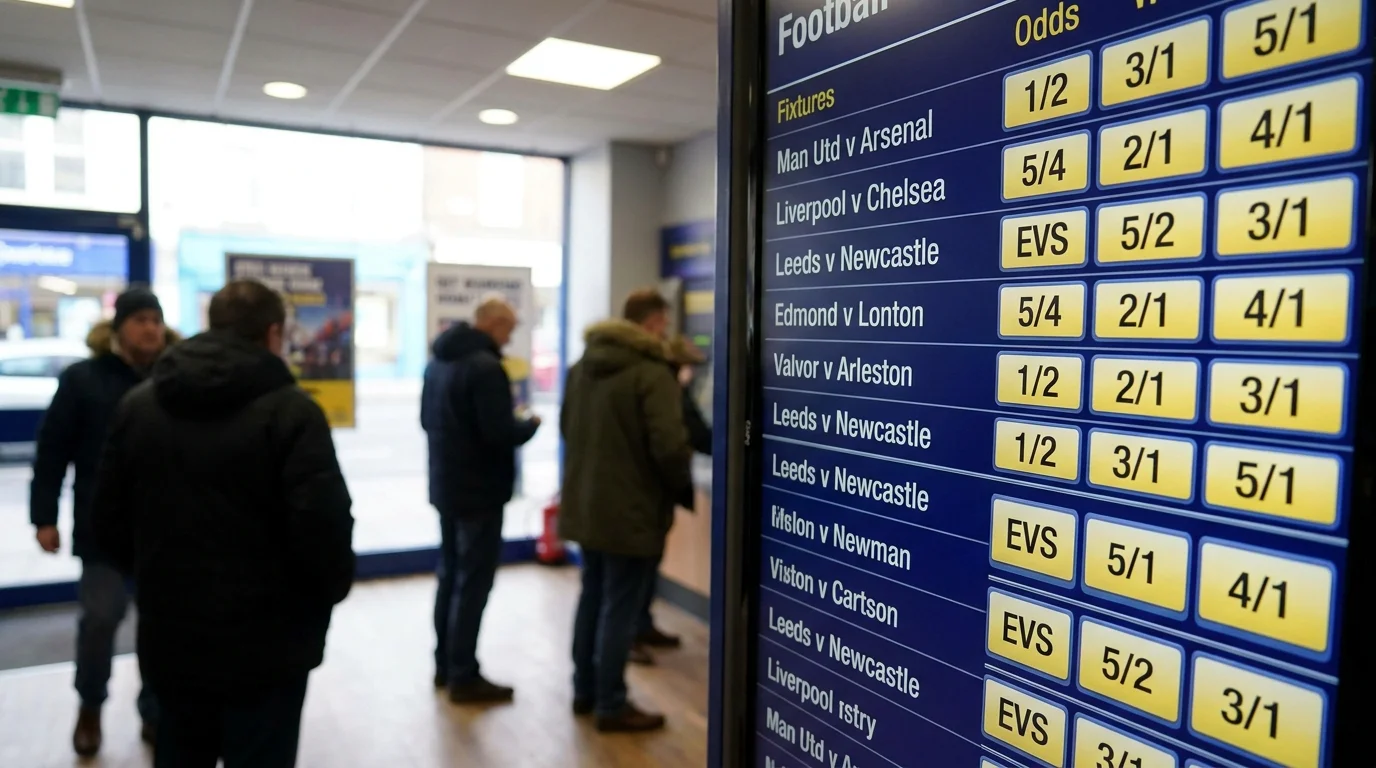
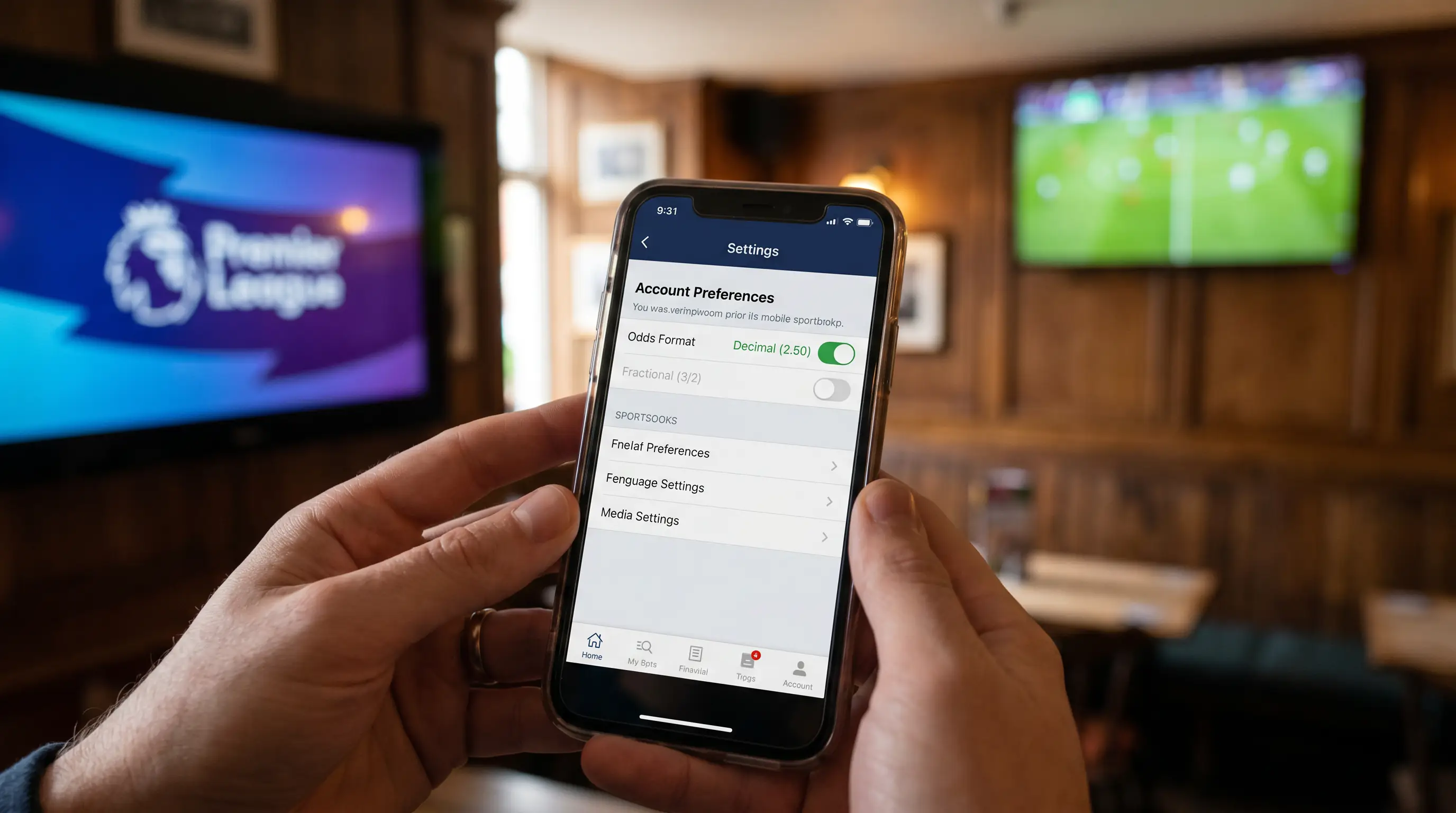
Walk into any high-street bookmaker in Manchester or Leeds and the boards still scream fractions: 5/2, 11/4, 4/6. Open the app from the same operator on your phone and you’ll usually find a small toggle in the settings letting you swap to decimals. Two formats, one product, and a generational split that refuses to die.
Fractional odds tell you the profit relative to the stake. A 5/1 selection returns five pounds in profit for every one pound staked, plus your stake back. A 4/6 favourite returns four pounds in profit for every six pounds staked. The numerator is your winnings, the denominator is your outlay. Simple enough until the numbers get awkward — most punters can convert 2/1 in their head, far fewer can do 13/8 cleanly under pressure.
Decimal odds bundle the stake into the number. A selection priced at 6.00 returns six pounds total for every one pound staked, which means five pounds profit. The decimal already includes your stake back, so the math at the till is just stake multiplied by the price. That’s why every betting exchange in the UK defaults to decimals, why traders use them, and why most professional bettors I know have switched permanently.
The reason fractions survive is partly cultural and partly horse racing. UK racing has used fractional pricing for over two centuries, and the broadcasters, the racecard publishers, and the older punter base all expect it. Football betting inherited the convention because the same bookmakers ran both books. Even now, with the online market dominated by mobile apps, fractional odds remain the default display on most high-street boards and on a chunk of UK-facing sportsbook desktop sites.
Converting Fractional to Decimal Without a Calculator
The formula is the cleanest part of this whole guide. Take the fraction, divide the top by the bottom, add one. That’s it. Five over two is two-point-five, plus one, equals 3.50. Eleven over four is two-point-seven-five, plus one, equals 3.75. Four over six is zero-point-six-six-seven, plus one, equals 1.67.
The plus-one step is where people lose the plot. Fractional odds describe profit only. Decimal odds describe total return. To bridge the two formats you have to add the stake back in, and “the stake back” in unit terms is just one. Forget that and you’ll consistently underestimate decimal prices by exactly one full unit, which over a season of bet sizing turns into a meaningful drift.
For the awkward fractions worth memorising as a UK football bettor — the ones that appear constantly on EPL match-result markets — I keep a short mental table. Evens (1/1) is 2.00. 6/4 is 2.50. 7/4 is 2.75. 9/4 is 3.25. 11/4 is 3.75. 13/8 is 2.625. 15/8 is 2.875. Memorise those nine and you’ll handle the majority of mid-range football prices without reaching for the phone.
Going the other way is just as straightforward. Take the decimal, subtract one, then express the result as a fraction over a common denominator. A 4.50 decimal becomes 3.50, which over a denominator of one is 7/2. A 1.80 becomes 0.80, which is 4/5. The arithmetic is identical to school fractions, dressed up in sportsbook clothing.
Implied Probability and the Quick Math That Matters
Conversion between fractional and decimal is mechanical. The conversion that actually changes how you bet is from price to implied probability — the percentage chance the bookmaker is effectively pricing in.

For decimal odds the formula is one divided by the price, multiplied by a hundred. A 2.00 selection implies a fifty percent chance. A 4.00 implies twenty-five percent. A 1.50 implies sixty-seven percent. You can do this in your head for round numbers and it changes how you read a market. Suddenly an EPL favourite at 1.40 isn’t just “short” — it’s the bookmaker telling you they think this team wins seventy-one times out of a hundred.
For fractional odds, the formula is denominator divided by the sum of numerator plus denominator, multiplied by a hundred. A 5/1 selection: six divided by one plus five, gives one over six, which is sixteen-point-seven percent. An evens shot: one divided by two, gives fifty percent.
The reason this matters more than the conversion itself: you cannot evaluate value without knowing the implied probability your bookmaker is pricing. If I think a Brentford home win against Aston Villa is roughly a forty percent shot, and the bookmaker has them at 2.30 — which implies forty-three-point-five percent — I am being offered worse than fair odds and should skip the bet. That entire calculation rests on knowing how to translate prices into percentages quickly.
Which Format Experienced Bettors Actually Prefer
Almost every serious bettor I work with uses decimals exclusively. The reason is not aesthetic preference, it’s friction at the moment of decision. When you’re scanning a card of ten Saturday-afternoon EPL fixtures and trying to compare prices across operators, decimals let you do the math at a glance. Is 1.91 better than 1.88? Yes, by exactly three pence per pound staked, and you can see that instantly. Is 10/11 better than 8/9? Most people have to stop and think. Some never quite get there.

Decimals also play nicer with spreadsheets. If you’re tracking yield, ROI, or running any kind of staking model, decimal prices feed directly into a multiplication and don’t need conversion at every step. Fractional inputs require a parser, and any parser introduces error.
That said, fractions retain one genuine advantage worth acknowledging — they communicate the shape of the bet more emotionally. “Fifty to one” sounds like a longshot in a way that 51.00 simply doesn’t. For outright markets, especially title race or top-scorer plays, the fractional headline still carries narrative weight that the decimal equivalent strips out. I keep my analysis in decimals and translate to fractions only when I’m explaining a bet to someone else.
The format question also intersects with how operators communicate promos. Best-odds-guaranteed offers, enhanced prices, and accumulator bonuses are almost always displayed in fractional terms in their headline copy, even when the underlying account runs on decimals. That’s a marketing decision, not a math one. Knowing both formats keeps you from being misled by the framing.
The Conversion Errors That Cost Punters Money
The single most common mistake I see, year after year, is the forgotten plus-one. A punter looks at 3/1 and decides that’s “three pounds back per pound staked”, forgetting that 3/1 returns four pounds total. Over a five-bet weekend, that misunderstanding alone can shift a staking plan by ten percent in either direction.

The second mistake is misreading short fractions. 4/5, 4/6, and 4/7 all look similar at a glance but represent meaningfully different prices — 1.80, 1.67, and 1.57 respectively. On a heavy-favourite EPL fixture, the difference between backing at 1.80 versus 1.57 is the difference between a viable value play and dead money. Slow down and read the denominator.
The third trap is mental shortcuts on awkward odds-on prices. 8/13, 4/9, 2/9, 1/3 — these are the prices on short-priced Champions League favourites and dominant EPL sides at home against bottom-three opposition. People estimate them as “roughly evens” or “about 1.50” and stake accordingly. They’re not. 1/3 is 1.33. 2/9 is 1.22. You’re being paid genuinely little to back the chalk, and if you’ve misread the price you’re staking as though you’ll be paid more.
The last one is currency confusion on each-way racing-style bets and their football equivalents. UK each-way fractions express the place portion as a fraction of the win odds — typically 1/4 or 1/5. If a top-scorer outright is 20/1 each-way at 1/4 the odds for the first three, the place portion pays at five-to-one, not at twenty-to-one. Misreading that turns an each-way play into a much worse risk-return proposition than you intended.
None of this is intellectually demanding. It’s all primary-school arithmetic dressed in bookmaker presentation. But under time pressure, with a market about to move and an app pushing notifications, even experienced bettors slip. Building the conversion muscle so it runs automatically is one of the cheapest edges available to a UK punter. If you want to layer the next step — turning these conversions into a fair-pricing framework — the deeper math is laid out in our piece on implied probability and bookmaker overround.
