
Championship Play-Off Final Betting: Inside the World's Most Lucrative 90 Minutes
 Available in US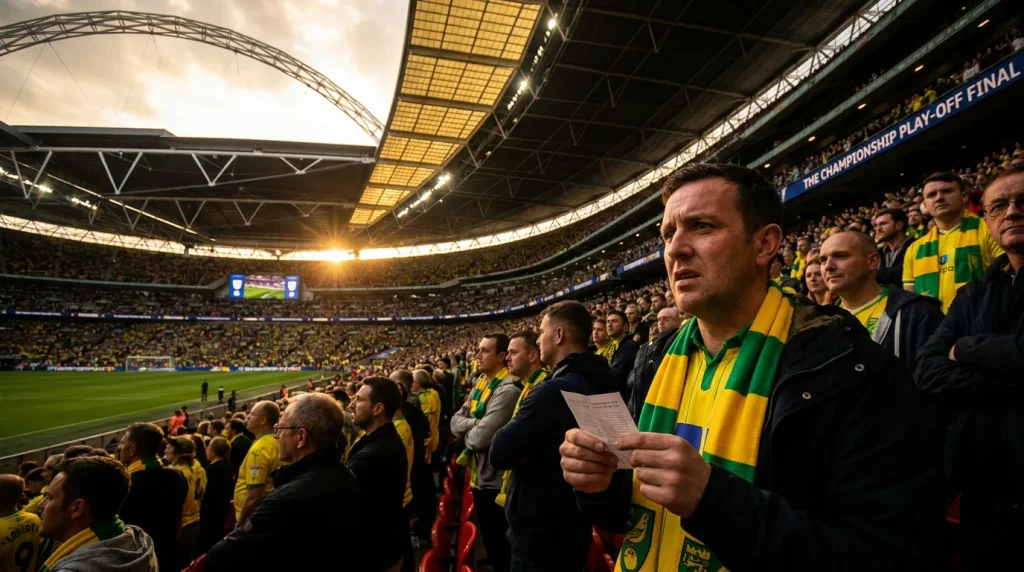
One match, ninety minutes, and a minimum of £205 million in first-season Premier League revenue waiting for the winner. The Championship Play-Off Final is the single most financially loaded fixture in world football, and pricing it as a betting market is genuinely harder than pricing any other single match in the English calendar. Deloitte’s analysis through Sportico put the prize at $275 million in immediate Premier League revenue for the winner, scaling up to as much as $490 million if the promoted side survives in the top flight. That weight of money on a single afternoon does things to the football that don’t happen anywhere else.
I’ve been to four of these finals in person and watched every one going back the better part of a decade. The pattern that emerges, season after season, is that the betting market consistently underprices the tactical conservatism that the financial stakes induce in both managers — and that mispricing is where the only reliable edge in this match lives.
The £205 Million Stakes and What They Do to Football
Promotion is worth at least £205 million in first-season Premier League revenue. The Sportico-Deloitte calculation that produces the $490 million ceiling assumes the promoted side stays up — which most don’t — but even the floor figure is the largest single-match financial prize in global sport. That number isn’t an abstraction. It’s a tangible weight sitting on every tactical decision both managers make.

The behavioural effect is observable. Managers who’ve been adventurous all season suddenly play with three defensive midfielders. Forwards who scored thirty league goals get instructed to drop deep and protect the ball. Goalkeepers play it long rather than rolling out from the back, even when the trailing side desperately needs to build possession. Risk aversion compounds throughout the match, and the underlying scoring rate runs measurably below what the participating teams’ season-long form would predict.
The market knows this in aggregate. The over/under 2.5 line is typically priced with the under side as the favourite, often around 1.65 under / 2.20 over. That’s already pricing for caution. The question is whether the pricing is cautious enough — and in my running tally across recent finals, the under has been correct slightly more often than the price implies, suggesting the market hasn’t fully internalised just how conservative both sides play at Wembley.
The other behavioural effect worth noting is on the substitutions. Both managers tend to make defensive substitutions earlier than they would in normal league fixtures, even when their side is the one needing a goal. The risk of conceding becomes psychologically larger than the upside of scoring, because the cost of losing is so visibly catastrophic. Extra-time betting markets benefit from this — if the match is tied at seventy minutes, the probability of going to extra time runs higher than the in-play market often prices.
Semi-Final Form Versus Final Day
The Championship play-offs are a structurally narrow funnel — only three of the past ten clubs that entered the play-offs from the third position have made it through to the Premier League, a strike rate of thirty percent. The semi-final, played over two legs, exhausts the participants both physically and psychologically. By the time the final arrives, both teams have already played 110-plus minutes of high-stakes football in the week before Wembley.

The implication is that semi-final form is a much weaker predictor of final-day performance than league form was for the semi-finals. The team that romped through their semi-final with two comfortable wins might be the team that arrives at Wembley physically fresher but tactically under-tested. The team that dragged through a tight aggregate win, perhaps via penalties, might be the team that arrives mentally hardened but physically depleted.
The market often weights recent form too heavily and league-season form too lightly. A side that finished sixth in the regular season but won their semi-final 4-1 on aggregate might be priced as a slight favourite at Wembley even though their season-long underlying numbers were inferior to their opponent’s. The opposite scenario — a fourth-placed regular-season side that scraped through their semi-final on penalties — might be priced as the underdog even though their full-season xG and form numbers suggest they’re the stronger team.
The work to do is comparing the two finalists’ full-season xG profiles, weighted to the second half of the season specifically, and using that as the primary input rather than the semi-final results. If your blended read disagrees significantly with the market’s pricing, that’s where the value lives.
Nerves and Tactical Conservatism
The Wembley final environment amplifies any latent nerves in either squad. Players who haven’t experienced this level of pressure before — and most Championship players haven’t — make different decisions than they would in routine league fixtures. The opening twenty minutes of most Championship Play-Off Finals are tactically cagey because both teams are managing their own anxiety as much as the opposition.

This nervousness affects the first-goal market specifically. The probability of any team scoring in the first fifteen minutes runs measurably below what the same teams’ league averages would suggest. Backing “no first-half goal” or “no goal in the opening twenty minutes” can be value plays on Wembley that wouldn’t be value plays in any other context for the same two teams.
Middlesbrough’s official statement following the integrity dispute around the 2025/26 play-off, where the club declared that “We believe this sends out a clear message for the future of our game regarding sporting integrity and conduct,” underlines just how high the emotional and reputational stakes can run around these fixtures. The financial pressure produces incentives that go well beyond tactical conservatism.
The other side of the nerves question is set-piece dominance. Teams with strong set-piece routines have a structural edge in tight, low-tempo finals because the set-piece is one of the few situations where tactical preparation reliably overcomes nerves. If one finalist has been notably more dangerous from corners and free-kicks during the season, their set-piece-related markets — total corners, anytime goalscorer for set-piece-strong defenders — can be subtle value angles.
Goalscorer and Correct-Score Edges
The first-goalscorer market on the play-off final is more variable than typical EPL pricing because the bookmaker has fewer reference points to work from. Championship players don’t have the same depth of historical data the engine relies on, and the per-player goalscorer prices can be meaningfully off the underlying probability for individual players with specific traits.

The players to look at are: penalty takers (because penalty probability runs above league average given the conservative tactics that lead to fouls in shooting positions), set-piece specialists (corners and free-kicks are disproportionate goal sources in tight finals), and ball-carrying central midfielders (who get into shooting positions more often when forward play is disrupted by tactical caution). These three player types tend to be slightly underpriced relative to the headline-name strikers, who are themselves often shorter than warranted because their league form attracts the casual money.
The correct-score market is where the financial-pressure-induced caution really expresses itself. The most common correct scores in Wembley finals are 1-0 and 2-1 — scorelines reflecting tight, defensive matches with one team finding a narrow advantage. The bookmaker’s correct-score market prices these specific outcomes reasonably accurately, but the price on 0-0 going to extra time can be more interesting than punters expect. The probability of a goalless ninety minutes in a final isn’t trivial, and the price typically offers enough to compensate.
Longshots and Extra-Time Pricing
Extra-time markets at the Championship Play-Off Final are structurally interesting because the tactical setup of the match makes extra time more probable than in a typical knockout fixture. The conservatism that suppresses scoring in regulation increases the probability of a goalless draw or one-all draw at ninety minutes, which means the “to go to extra time” market sometimes prices in the eight-to-twelve-percent range when the underlying probability is closer to fifteen or twenty percent.

This isn’t an enormous edge but it’s a persistent one. The extra-time scenario is also where one of the contestants tends to break first — either physically or mentally — and the side that’s been managing the match better through regulation typically wins more often in extra time than the headline form would suggest. Backing the technically stronger side specifically in the “in extra time” or “via extra time” markets can be a layered value play.
Penalties as a settlement method are rare but not vanishingly so — they happen in roughly one in eight to one in ten of the play-off finals across the past two decades. The “to be decided by penalties” market is usually priced around 7.00 to 9.00, which is close to fair value but occasionally drifts longer if the bookmaker reads one side as significantly stronger tactically. Those drift moments are where the penalty market becomes interesting.
For the related question of how outright promotion markets price the journey to this final from earlier in the Championship season — and where the value windows appear before the play-offs even begin — see the analysis in the piece on Championship promotion odds.
