
The First Goalscorer Market: High-Variance Edge for Patient Bettors
 Available in US
I’ve been backing first goalscorers since I was eighteen and I’ll still occasionally take a 14/1 punt on a midfielder who I think has a sneaky chance of running onto a knock-down in the opening twenty minutes. It’s the most romantic market in football betting and also the most quietly exploitable, because the bookmakers price these markets using inputs that lag behind tactical reality more than any other major market on a Saturday afternoon.
Opta’s contextual model considers up to twenty factors per shot when calculating xG — pass type, defender positions, goalkeeper situation. The first goalscorer market is, in essence, a question about which player will be on the end of the highest-quality shot before any other player in the match. The bookmaker’s model has to combine each player’s shot frequency, shot quality, minutes likelihood, and team scoring rate, and that’s a lot of moving parts. Where moving parts multiply, pricing errors creep in.
First Versus Anytime Versus Last
The three core goalscorer markets — first, anytime, and last — are pricing three very different probabilistic events that the casual punter often treats as the same question.

Anytime goalscorer is the cleanest. It asks: will this player score at any point in the match. The probability is roughly the player’s scoring rate per ninety minutes, adjusted for expected minutes played, adjusted for the fixture context. The market is heavily traded, the prices are sharp, and the edge is hard to find on premium-name strikers but reasonable on second-tier names where the bookmaker’s model has thinner data.
First goalscorer asks a much narrower question: will this specific player score before anyone else. The math is conditional — it requires the player to score, AND it requires no other player to score before them. The conditional layer means the probability is significantly lower than anytime, and the prices are correspondingly longer. A striker priced at 2.50 anytime is often priced at 6.00 to 7.00 first.
The relationship between the two prices is information. If a player’s first/anytime ratio is unusually wide on a given operator, it’s often a sign the bookmaker is conservative on early-goal probability for that fixture overall — which can be exploitable if your read disagrees.
Last goalscorer is the mirror image of first. It’s most commonly played as a hedge — backing the favourite striker for first AND a longer-priced striker on the opposing team for last, in case the match swings late. The pricing on last is structurally similar to first but with one critical wrinkle — the introduction of a late substitute can dramatically affect who scores last in ways that pre-match modelling can’t capture.
Minutes Played and Shot Share
The single most underrated factor in first goalscorer analysis is expected minutes played. The bookmaker prices the market on Friday based on the most likely line-up. If the actual line-up changes — if your fancied striker is rested for European football, dropped for tactical reasons, or replaced because of a knock the team didn’t disclose — the price you took on Friday no longer reflects the match that’s actually being played.
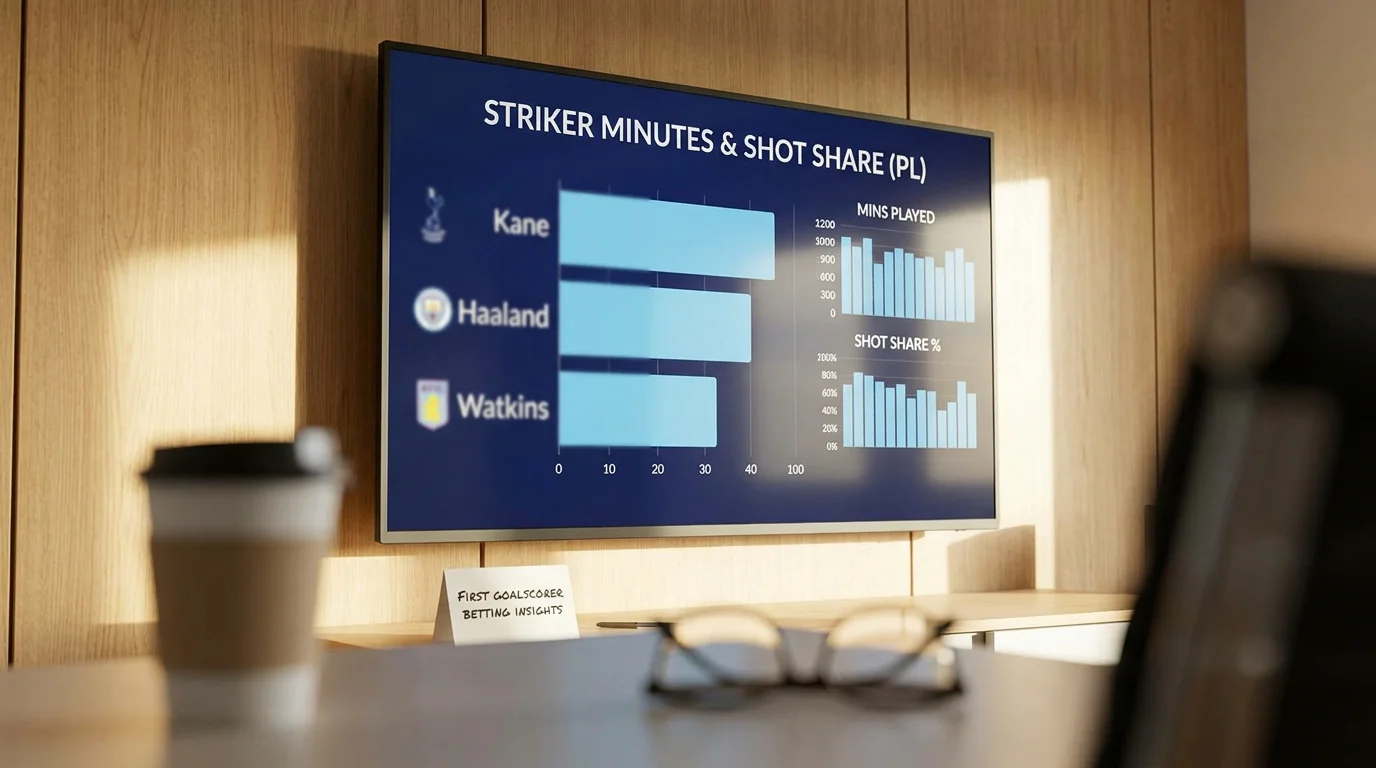
Opta’s models train on a base of around a million historical shots, so the underlying per-shot scoring probability for any given player in any given context is well-quantified at scale. The first-goalscorer market’s pricing weakness isn’t in the per-shot math — it’s in the upstream forecasting of how many shots each player will actually take, which depends on minutes, role within the tactical setup, and the match state through the first goal.
The metric I lean on most is rolling shots per ninety, ideally split into shots from inside the box versus outside. Players who take six or seven shots per ninety with three or four inside the box are first-goalscorer candidates at almost any operator’s price, because the conditional probability of being on the end of the highest-quality first shot in a match is structurally high for them. Players who take eight shots per ninety but six of those are from outside the box are anytime candidates rather than first-goalscorer candidates — they’ll often score, but rarely first.
The penalty taker is the other identification that matters. If a designated penalty taker is on the pitch and the match has any meaningful probability of producing a penalty in the first half-hour, that player’s first-goalscorer probability gets a meaningful uplift the market doesn’t always fully price.
How Bookmakers Price First Goalscorer
The pricing model on first goalscorer combines a per-player anytime probability, a per-player average minute-of-first-goal distribution, a team-level total goals expectation, and a no-goalscorer (0-0) probability. The output is a per-player first-goalscorer price plus a “no goalscorer” price for the 0-0 scenario.
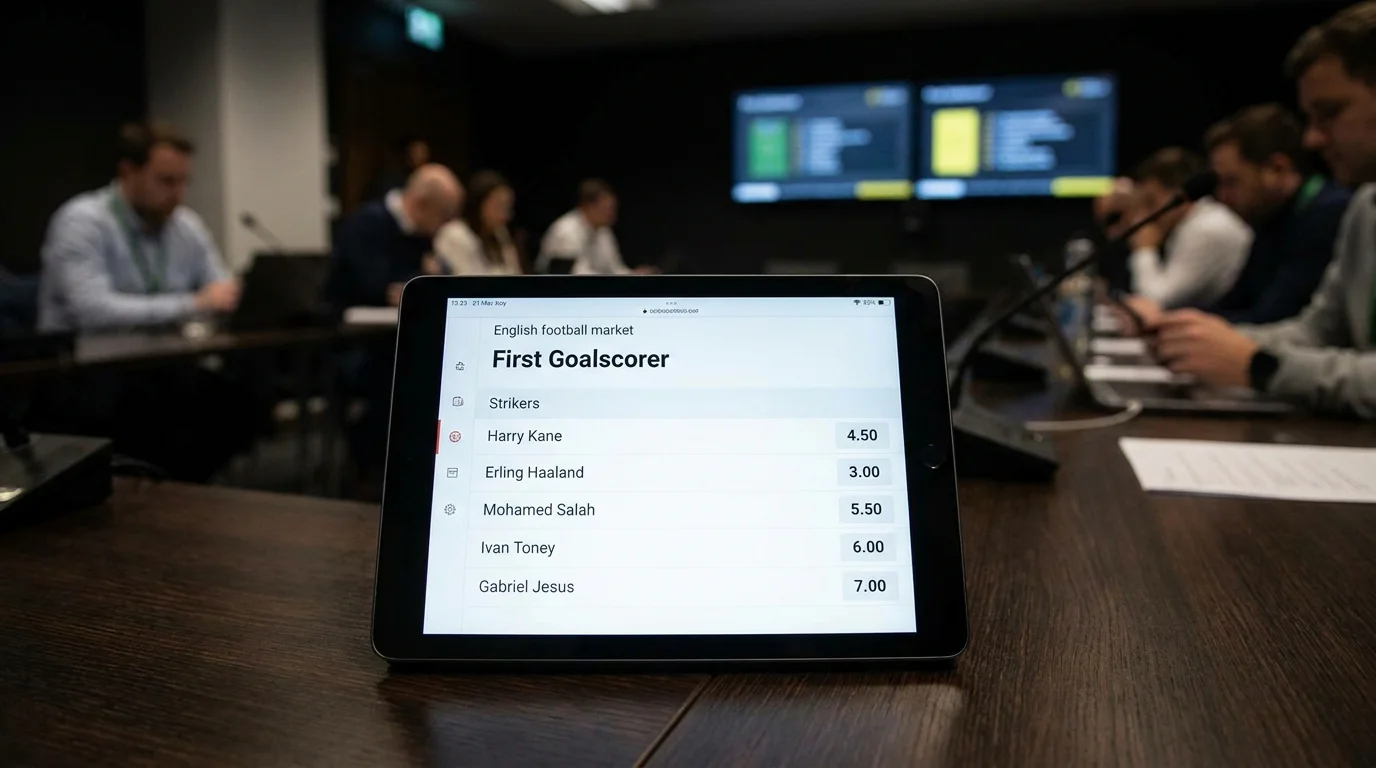
The model is sensitive in places that aren’t intuitive. A player who scores early in matches (lots of fifteenth- and twentieth-minute goals in his history) gets a meaningful first-goalscorer uplift versus a player with the same anytime probability who scores predominantly in the seventieth to ninetieth-minute window. The market reflects this if the operator’s data is rich enough to capture timing distribution, which not all operators’ data is.
The conservative bias I see most often is on second-tier strikers from clubs outside the top six. The pricing model often defaults to a relatively flat minute-of-first-goal distribution for these players, which underprices the ones who specifically score early in matches because they play in counter-attacking systems that produce early transitions. Identifying these players from match-by-match film and goal-timing data is where genuine edge lives.
The other systematic bias is on midfielders priced relatively short because of a recent flurry of goals. The model captures the recent uptick but doesn’t always discount sufficiently for the shot-quality distribution being more “outside-the-box hopeful” than “inside-the-box probable”. These shorter-priced midfielders are often worth fading on first-goalscorer, even when anytime backing them might still be reasonable.
Best Odds Guaranteed on Goalscorers
BOG was originally a horse-racing concession and translated into football most cleanly on the goalscorer markets. The reason is that goalscorer prices drift more between morning and kick-off than match-result prices do — team news, tactical reads on substitutes, late injury reports — and BOG captures the upside if your selection’s price lengthens after you’ve taken it.
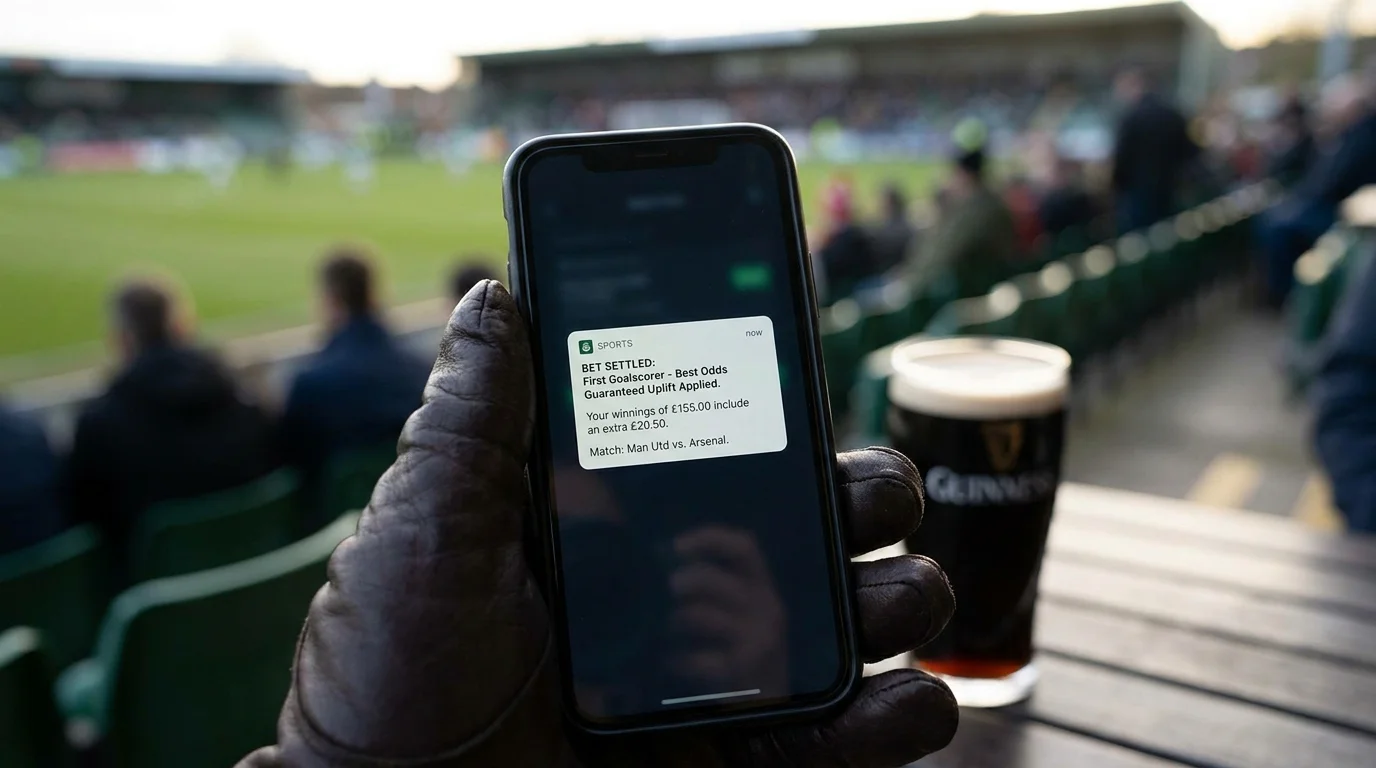
The application is highest-value on midweek fixtures where line-up uncertainty is greatest. A 14/1 first-goalscorer pick taken at Monday’s opening price often drifts to 16/1 or 18/1 by Wednesday evening’s kick-off if the player’s role becomes uncertain. With BOG attached, you settle at the longer price. Without BOG, you’ve paid the early price for nothing.
The application is lower-value on weekend EPL fixtures where the major operators set their markets reasonably efficiently from Thursday morning onward. Goalscorer prices move less, BOG triggers less often, and the concession ends up being neutral. The structural value of BOG is therefore concentrated in the parts of the calendar most punters don’t bother with — midweek EFL Championship and EFL Cup fixtures, where the line uncertainty is highest and the BOG payouts are most likely.
Discipline Around Late Team Changes
The single biggest discretionary failure I see in first-goalscorer betting is punters refusing to walk away from a position when team news has fundamentally changed the bet. Your striker is named on the bench rather than starting. The penalty-taking captain is rested. The opposition has unexpectedly switched to a back five. Any of these can erase the value you originally identified — and the disciplined move is to acknowledge that and move on, rather than holding to a thesis that no longer exists.

The market typically suspends and reopens about an hour before kick-off when confirmed line-ups are released. That window is the cleanest opportunity to reassess. If your selection is starting and the structural read still holds, you keep the bet. If your selection isn’t starting, the smart move is often to cash out at whatever offered price exists, even if the offer is short of the original stake — the bet is no longer the bet you intended to make.
The other discipline question is on multiple-leg builders that include a first-goalscorer leg. If the goalscorer leg loses in the third minute because someone else scores the opening goal, the rest of the builder is dead, but a lot of punters mentally continue “watching” the match and feeling involved. That emotional involvement is the cost of stacking high-variance legs onto a builder, and it’s worth examining whether you’ve sized the position appropriately for the expected variance.
The patience question is harder. First-goalscorer markets have hit rates around eight to fifteen percent on the prices I’m typically backing, which means losing weeks are routine and discouraging. The yield only crystallises over a properly sized sample — say, a hundred bets minimum — and tracking the running ROI honestly is the only way to know whether your edge is real. For the broader question of how to manage stakes across multi-leg ticket strategies that include high-variance legs like FGS, the underlying probability math is in our piece on player props on the Premier League.
