
League One Betting: Finding Edge in the EFL's Third Tier
 Available in US
I’ll be honest — I almost didn’t write this piece, because the moment a market gets too profitable to talk about, the market tends to stop being profitable. League One is one of those uncomfortable middle spaces in English football betting where the data is patchy enough to deter serious money but the pricing is loose enough that careful work can actually move the needle. Deloitte’s analysis of Football League finances showed twelve Championship clubs collectively pumped £554 million of owner equity into the second tier in the 2023/24 season, with the top three of those contributing about seventy percent. That cash pressure cascades down — clubs falling out of the Championship into League One carry parachute payments and inflated wage structures that distort the competitive landscape, and that distortion is where the betting opportunities live.
What follows is the structural read I work from when I’m pricing League One fixtures. It isn’t a magic formula. It’s a framework that respects the data gap and exploits the inefficiencies that gap creates.
The League One Data Gap and Why It Matters
EPL is data-saturated. Every shot, every pass, every defensive action is tracked by multiple providers, the public xG sources are reasonably accurate, and the bookmaker pricing reflects all of that information almost instantly. Championship has slightly thinner data coverage but is still well-served by the major providers.

League One is different. The professional data providers cover it, but the public-facing xG sources are noticeably less reliable, the broadcast coverage is thinner, and the bookmaker’s automated pricing engines have less rich input than they do on higher divisions. This isn’t a bug in the betting market — it’s a structural fact of the data ecosystem, and it creates the conditions for pricing inefficiency.
The practical implication is that information gathered manually — from the local press, from individual match attendance, from following specific clubs’ tactical evolution closely — has more relative value at League One than at EPL. The bookmaker is not necessarily better-informed than a dedicated punter, because the bookmaker’s information advantage comes from data feeds that are themselves thinner at this level.
I once placed a position on a League One mid-table club priced as a heavy underdog against a parachute-payment side, on the basis that the underdog’s first-choice attacking midfielder — who’d been injured for six weeks — was back in training and likely to start. That information was available to anyone reading the club’s local newspaper for free. It didn’t appear in the bookmaker’s pricing because the trading model wasn’t ingesting that level of granular team news. The match was a 2-2 draw. The position paid out at long enough odds to justify a season of similar research.
Promotion and Relegation Dynamics
League One has the highest churn of any English division. Three teams come up from League Two, three drop from the Championship, four play in the play-offs at the top, and four relegate at the bottom. That much movement means the makeup of the division changes substantially year to year, and the betting market needs time to recalibrate at the start of each season.
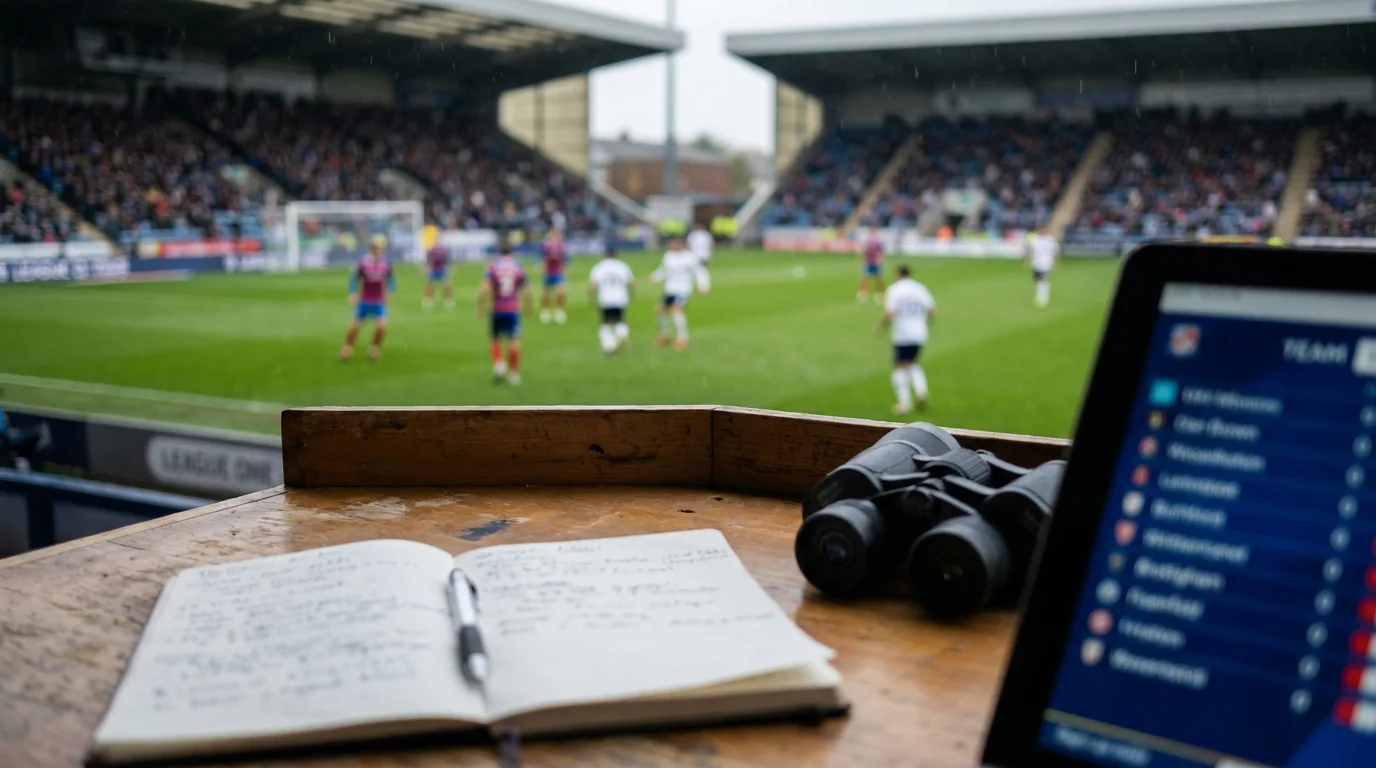
The parachute-payment clubs falling from the Championship are the most distorting feature. These clubs arrive with squad budgets two or three times higher than the established League One competition, and the betting market often prices them as overwhelming favourites for promotion in August. That promotion-favourite pricing is sometimes justified and sometimes catastrophically not — Championship-relegated clubs frequently struggle with the physical and tactical demands of League One, lose their best players to clubs in higher divisions, and end up mid-table or worse.
The honest read on parachute clubs in League One: about half of them stabilise quickly and challenge for promotion, about a quarter struggle for a season and reorganise, about a quarter implode entirely. The market’s pre-season price doesn’t reliably distinguish among these three trajectories, which means the bet to fade a parachute favourite in late August or September — after the first six matches have revealed which trajectory they’re on — can be one of the cleanest promotion-market plays of the year.
At the relegation end, the math is different. Clubs heading into League One after promotion from League Two are typically priced as relegation favourites in August. About forty percent of them survive comfortably, about thirty percent survive after a struggle, about thirty percent go straight back down. The market is more accurate at the relegation end because the data on League Two-promoted clubs is genuinely worse than at any other level, and the pricing is correspondingly more conservative.
Match Result Versus Totals on League One Fixtures
The 1X2 market on League One is sharper than the totals market in my experience, which is the opposite of what punters usually expect. The reason is that bookmakers focus their pricing attention on the most-bet markets, and 1X2 is the headline market that attracts most casual money. Totals — over/under 2.5 in particular — get less trading attention and the model-driven default prices have wider error bars.
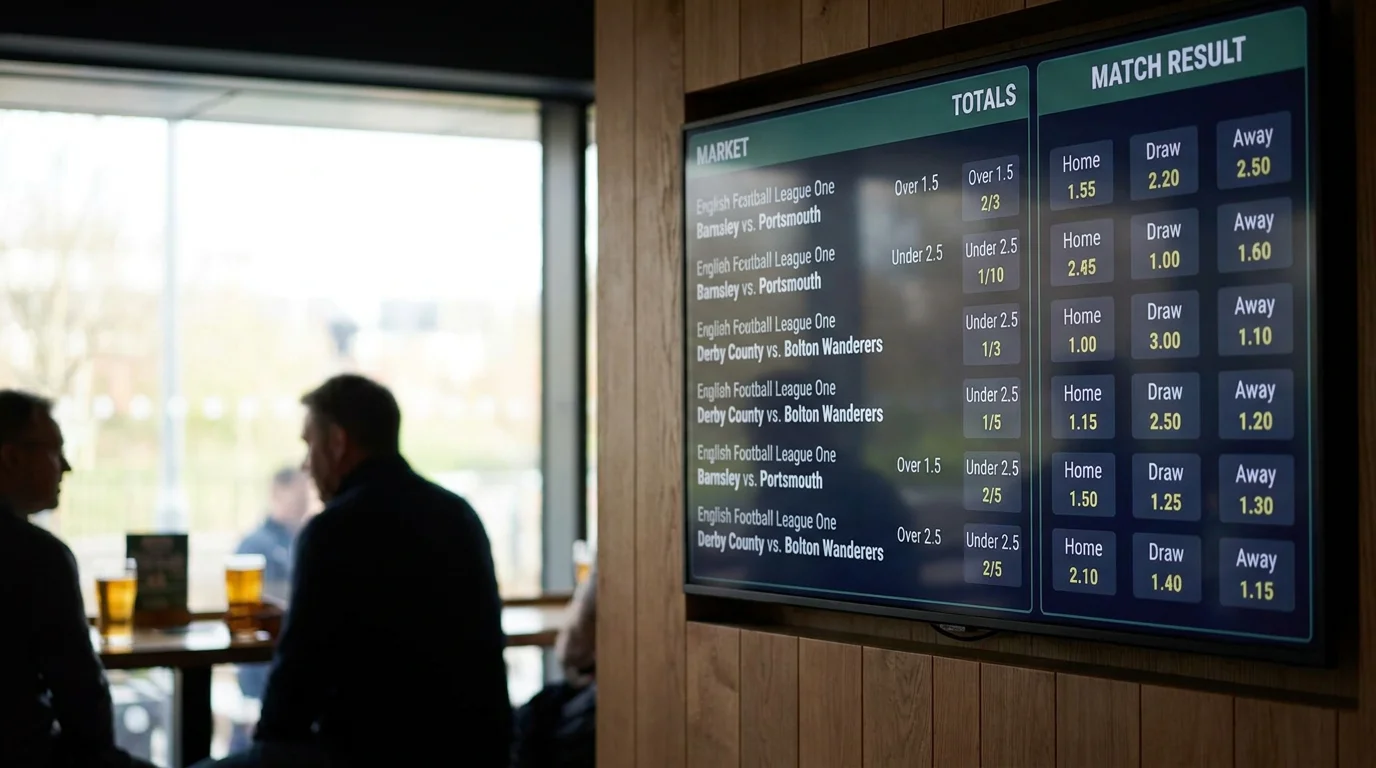
The strongest single edge I’ve found on League One is on the under 2.5 line for fixtures involving two defensively-organised mid-table sides. These matches systematically end 1-0 or 1-1 because both teams play with similar shape, similar pace, and similar offensive limitations. The 2.5 line might be priced at 1.90 over / 1.90 under, when the true probability of two-or-fewer goals is closer to fifty-five percent. The under is consistently the value play in these specific match-ups.
The opposite case — over 2.5 on attacking-versus-attacking League One fixtures — is less reliable, because the underlying scoring distribution in the division is lower than EPL or Championship and the over 2.5 line gets priced more conservatively than the underlying chance creation might warrant.
On 1X2, the cleanest edge is on the draw price for tight fixtures. The market’s default draw price for evenly-matched League One sides is typically around 3.20 to 3.40, which implies about thirty percent. The actual draw rate on League One matches between similarly-ranked sides runs higher than thirty percent in my data, suggesting modest value on the X. It’s not enormous but it’s persistent enough to be worth incorporating.
How Parachute Payments Shape the Odds
The parachute payments that follow Championship-relegated clubs into League One are usually three years of significant top-ups, designed to soften the financial cliff between Premier League broadcast revenue and lower-division revenue. The amounts are public and they shape betting markets in two specific ways.
The first effect is on outright promotion odds. A first-year parachute club is typically priced 1.80 to 2.50 to be promoted back to the Championship — a heavy implied probability that reflects the squad budget advantage. As noted earlier, this price often overestimates the actual probability of immediate promotion. A more accurate market read on these clubs is somewhere between 2.50 and 4.00, depending on how cleanly they’ve kept their squad together post-relegation.
The second effect is on individual fixture pricing. A first-year parachute club priced heavily favourite against an established mid-table League One side — say at 1.60 or 1.70 — is often pricing the squad strength rather than the current form, and during the team’s struggle period that pricing can be meaningfully off. Backing the established mid-table side at 4.50 or longer in these fixtures can be a value play once the parachute team’s actual early-season trajectory has been observable.
The financial pressure on parachute clubs also creates tactical instability. Managers come and go faster than at higher tiers because the financial cost of failing to bounce back is enormous and the boards have less patience than they would in the Championship. Each managerial change is a tactical reset that the market is slow to price, particularly on the interim manager’s first few matches. Studying these transition windows specifically is one of the highest-yield activities a League One bettor can pursue.
Finding the Information Edge That Actually Pays
The honest summary of League One betting strategy is that the edge is in the work, not in any single magic angle. The data is patchier than the higher divisions, the bookmaker pricing is correspondingly less precise, and the bettors who profit consistently are the ones doing manual research that scales poorly but produces genuine insight.

The five inputs I prioritise on every League One fixture: starting-eleven prediction based on the most recent reliable team news, the manager’s tactical setup against this specific opponent profile, the home-versus-away pace differential of both sides, the recent xG-for and xG-against over eight matches, and any specific contextual factor like weather or pitch conditions. None of these is exotic. All of them require time spent that most punters don’t put in.
The fixtures to skip are the ones where you don’t have all five inputs reliably available. League One is a market where saying “I don’t have a view” is itself a valuable discipline — there are thirty other fixtures across the weekend, you don’t need to bet every one. The bookmakers count on punters feeling obligated to have an opinion on everything; the punters who succeed are the ones who only bet when their view is genuinely better than the market’s.
For the continuation of this analysis into the EFL’s bottom tier — where the data gap widens further and the structural edges shift again — see the piece on League Two betting.
