
Cash Out in Football Betting: When It Saves You, When It Costs You
 Available in US
Cash out is the most psychologically clever product UK sportsbooks have ever launched. It turns every football bet into a live emotional decision, hands the punter the illusion of control, and quietly extracts a margin on top of the original price. Around 290 million online bets a month flow through UK operators on real-world events, and a meaningful share of them are now subject to mid-match exit prices that didn’t exist as a concept fifteen years ago.
I’ve watched friends cash out a winning Premier League accumulator at the seventy-fifth minute for half what the full payout would have been, then spend the rest of the match staring at the final score and quietly calculating what they “lost”. I’ve also watched the same friends ride a bet to ninety minutes for an extra ten pounds of profit, only to be levelled by a stoppage-time equaliser. The right answer is never the obvious one. The wrong answer is treating cash out as a default rather than a calculated choice.
What Cash Out Actually Is, Beneath the Marketing
Cash out lets you settle a bet before its natural resolution at a price the bookmaker offers in real time, based on the current state of play. The headline framing is that you’re “locking in profit” or “cutting your losses”. The mechanical reality is that you’re voluntarily entering a second transaction with the operator at a price they’ve set, on top of the first transaction you already entered.
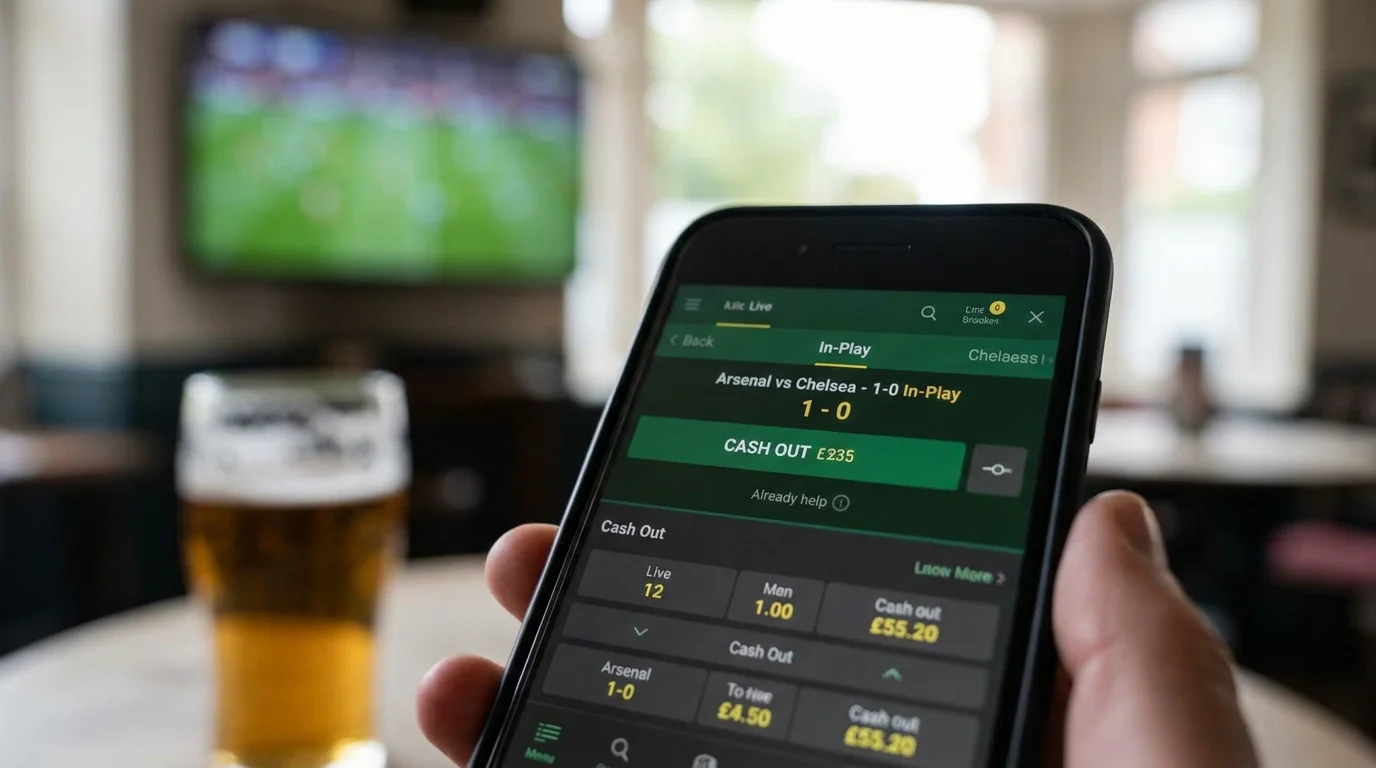
The mechanism works like this. The operator calculates the implied probability of your bet winning from this moment forward, applies their margin to that probability, and offers you a cash settlement equal to the discounted value of the remaining bet. If you’re holding a £10 bet at 4.00 that’s currently winning, with thirty minutes to go and the favourite still leading by one, the fair price of that position might be roughly £32. The operator might offer you £28 to walk away. That four-pound gap is the cash-out margin and it goes nowhere except into their book.
The product was invented to solve a specific problem: punters with winning long-running bets were psychologically uncomfortable holding to settlement and were ringing trading desks asking to “sell” their bets back. The operator’s solution was to systematise the offer at a price that suited them and bake it into the app. The product spread fast because punters love the feeling of control, and operators love the margin extraction.
The Hidden Margin Inside Every Cash-Out Offer
Every cash-out price contains a margin that’s narrower than the pre-match book but never zero. If the fair value of your remaining bet is X, the cash-out offer is typically X minus somewhere between five and twelve percent depending on the operator, the market, and the time remaining. The exact number is rarely disclosed and varies dynamically.

You can test this on any winning football bet by comparing the cash-out offer to the implied price of the same outcome in the live market. If you backed Liverpool win at 1.80 pre-match and they’re up 2-0 at half-time, the live “Liverpool win” market might be trading at 1.20 — implying eighty-three percent — while the cash-out offer settles you at a number consistent with the bookmaker pricing your win chance at maybe seventy-eight percent. That five-point spread is the trading desk’s working capital.
Over enough cash-out transactions, the margin extracted from a punter compounds significantly. A bettor who routinely cashes out at the seventy-fifth minute on long-running multiples can give up ten to fifteen percent of theoretical edge across a season. None of that loss shows up in any single transaction. It accumulates in the gap between cash-out yield and hold-to-settlement yield, which is precisely the number no operator app displays back to its users.
Partial Cash Out and Auto Cash Out
The product has evolved into two refinements that deserve their own treatment because they change the math.

Partial cash out lets you take a portion of the offered settlement and leave the remainder of the bet live. Operationally this is two bets — one settled now at the offered price, one continuing at the original stake reduced proportionally. The margin still applies on the settled portion, so partial cash out doesn’t escape the cost. What it does is split the emotional outcome: you bank something visibly, you still have skin in the result. For punters who otherwise can’t resist full cash-out, partial cash-out can be a tolerable compromise that preserves some of the original edge.
Auto cash out lets you set a trigger price in advance — “settle this bet automatically if the cash-out offer reaches £50” — and walks away from the screen. The math here is interesting because auto cash out removes the in-play emotional decision and replaces it with a rule. If the rule is set sensibly, auto cash out can be a discipline tool. If the rule is set reflexively at a low threshold, it becomes a margin-extraction mechanism running on autopilot.
The case for auto cash out is strongest on accumulators where you have a clear pre-defined profit target and don’t want to watch the final leg. The case is weakest on single bets where the offered price closely mirrors the live market — you’re paying margin for the convenience of not making the decision yourself.
When Cash Out Makes Mathematical Sense
There are situations where taking the cash-out price is the correct decision even with the margin baked in. The first is when something has materially changed about the bet that the original pricing didn’t reflect. A red card in the eighteenth minute on a team you’ve backed to win is the textbook case — the live market reprices accordingly, the cash-out offer reflects the reprice, and your downside if you hold is genuinely uglier than the discount implied by the cash-out margin.
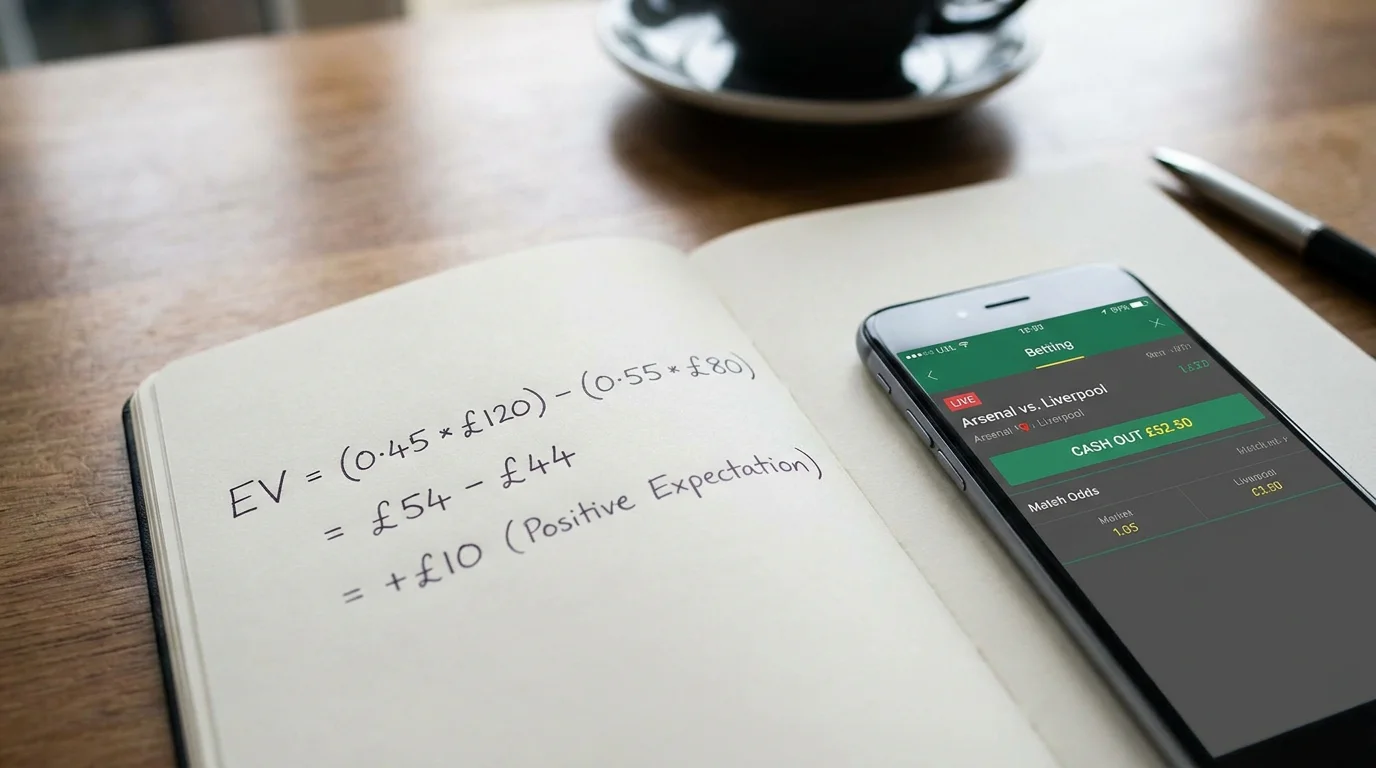
The second is information asymmetry on your side. If you placed the bet based on a specific tactical read — say, that a team would press high and dominate possession — and the first thirty minutes have shown that read to be wrong, cashing out at a small loss is rational. You no longer believe in the position, the bookmaker is offering you an exit, and refusing to take it is a sunk-cost decision.
The third is bankroll management. If a single bet has grown to a size where its loss would materially damage your capacity to continue betting at planned stakes, cash out functions as risk management even with the margin. This is the long-running accumulator scenario — a £20 stake at 50.00 with one leg left is psychologically a £1000 ticket, and the operator knows that’s why so many punters take whatever exit is offered. Sometimes that decision is defensible. Often it isn’t.
The fourth is when the offered price clearly exceeds the fair price implied by the live market. This is rare but it happens, usually when the operator’s algorithm hasn’t caught up with a market move in the first few minutes after a significant event. If you’re watching live and the score-line implies one cash-out value but the offer is meaningfully higher, take it. Grainne Hurst, the CEO of the Betting and Gaming Council, has been clear that punters care about outcomes rather than process — and the cleanest outcome you can extract is a mispriced cash-out offer accepted before the algorithm corrects.
When Letting the Bet Ride Is the Stronger Play
The default psychology of UK gambling culture leans heavily toward cashing out, and that default leans against the punter. Around seventy-three percent of UK adults already view gambling as a risk to family life — the operator-facing sentiment is hostile enough that “lock in profit” messaging meets a receptive audience. But sentiment isn’t strategy.
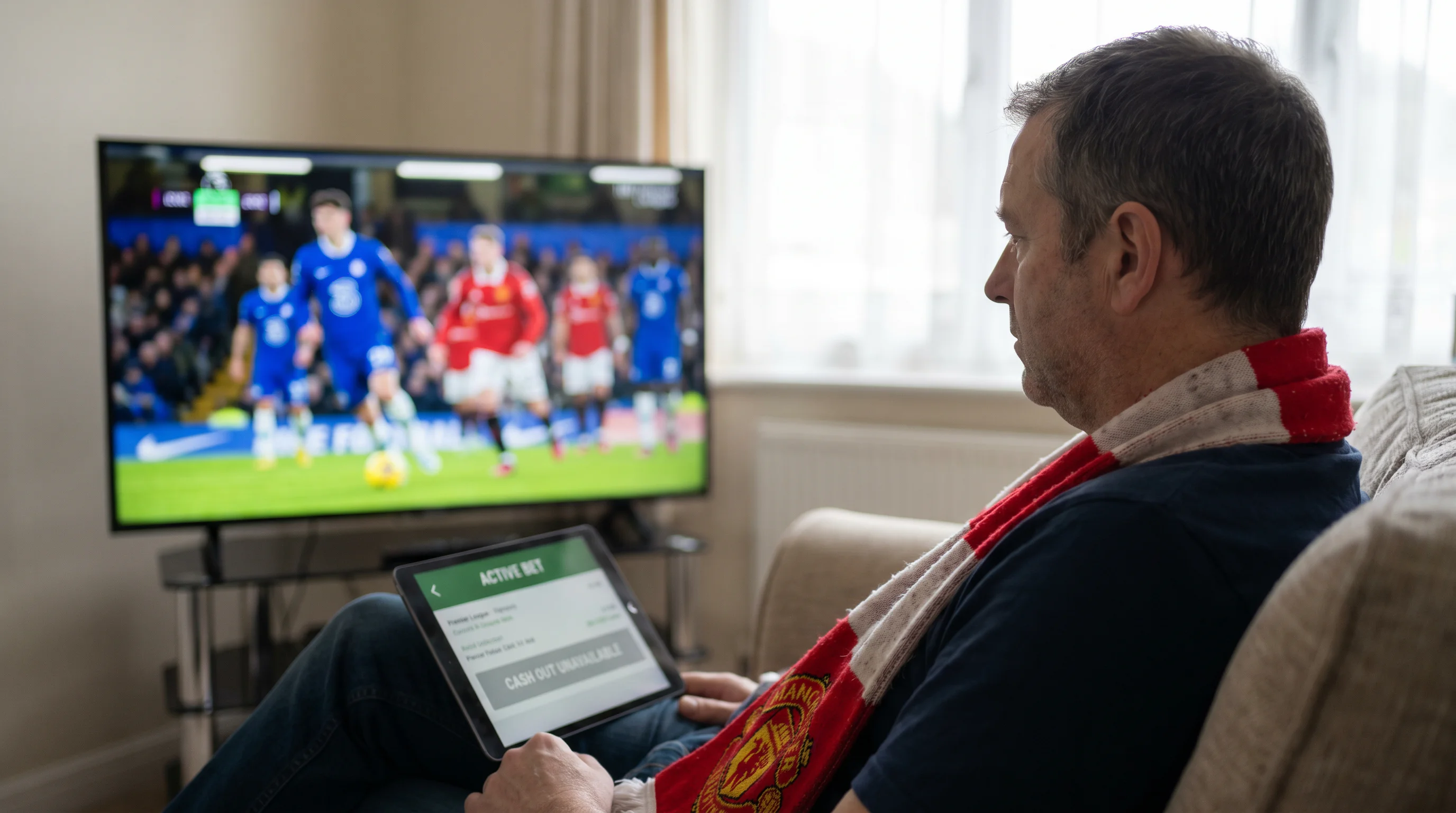
The case for holding is strongest when nothing material has changed in the bet’s underlying probability. If you backed a pre-match favourite, the favourite is still on serve, and the only thing that’s happened is time elapsing, the cash-out offer is asking you to pay margin for the passage of clock. You’d be paying to exit a position that’s working as intended.
The case for holding is also strong when you’ve placed a bet based on a thesis that’s still unfolding. If your thesis was that home xG would dominate over ninety minutes and the team has under-converted in the first half, cashing out at a small profit means walking away from the expected value you originally identified. The discomfort of waiting is not the same as the position being wrong.
And on accumulators, the math is brutal. A four-fold at 8.00 that’s three legs in with one to go is offering you cash out at maybe seventy percent of full payout — but the final leg is, by definition, a bet you already analysed and thought was good value. If you still believe the final leg, taking thirty percent off the top to walk away is paying a fee to avoid an emotion. That fee is exactly what the operator is monetising.
The discipline question becomes a tactical question once you start measuring your own cash-out behaviour. Track every cash-out decision for a season, settle the rest of the bet on paper at the actual outcome, and compare your realised yield to your hypothetical hold-to-settlement yield. If the gap is meaningful and against you, the conclusion writes itself. If you want the deeper math on how multiples compound the cash-out margin problem, the analysis is in our piece on accumulator math and probability.
