
Both Teams to Score: A Strategy Built Around xG Asymmetry
 Available in US
BTTS is the market I cut my teeth on. Back when I started taking football betting seriously, it was the one line where I could clearly articulate why my number disagreed with the bookmaker’s — and that articulation became the discipline that shaped everything else. The 2025/26 EFL Championship season produced a record 1,438 goals across 552 matches, an average of 2.61 per fixture, and that goal-rich environment is exactly the kind of context where BTTS strategy comes alive or gets crushed depending on how you read it.
Most punters approach BTTS lazily. They look at recent BTTS yes results for both sides, they take the longer of the two trend rates, and they back accordingly. That’s not strategy. That’s pattern-matching on outcomes. Real BTTS strategy reads the underlying shot quality and defensive structure that produced those outcomes, and that’s a different exercise altogether.
The Fundamentals of the BTTS Market
BTTS is binary. Both sides need at least one goal each for “yes” to settle, anything else settles “no”. The simplicity is the appeal — there are no edge cases on goal types, no extra-time complications in regular league fixtures, no settlement disputes. Either both teams have hit the back of the net by ninety minutes or they haven’t.
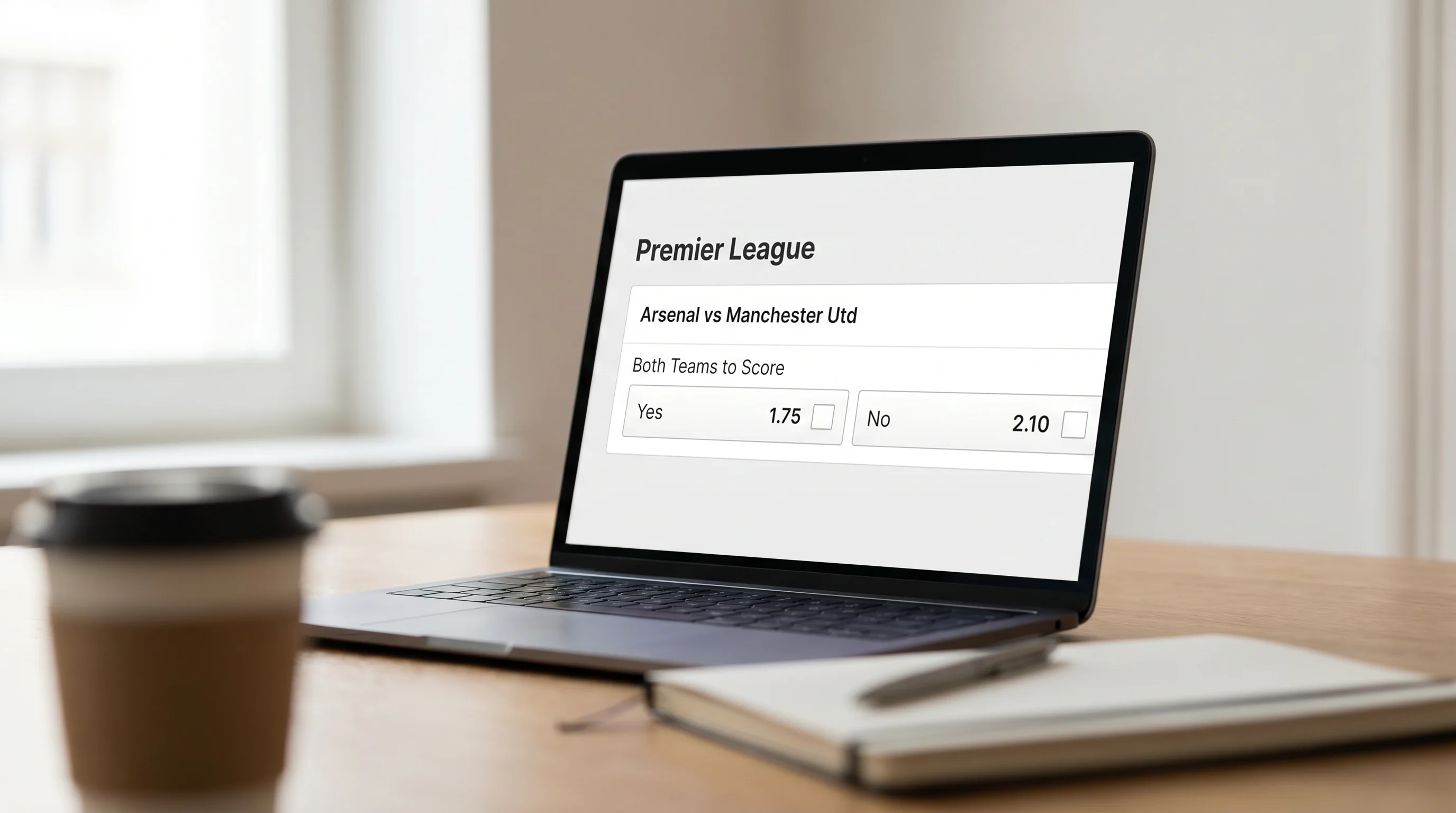
The market typically prices yes and no fairly close to each other on neutral fixtures — yes around 1.70-1.85, no around 1.90-2.10, with the bookmaker’s combined margin somewhere between five and eight percent depending on the operator. On heavy-favourite EPL fixtures where the favourite is dominant and the underdog is defensive, the no side can drift to 2.50 or longer because the script for “favourite wins comfortably without conceding” is one of the most common single-match outcomes in top-flight football.
The key statistical fact about BTTS is that it’s far less correlated with the result than people assume. A 3-2 home win and a 1-1 draw both settle yes. A 4-0 home win and a 0-0 draw both settle no. The market sits orthogonally to the match-result market and that’s why it has its own pricing dynamics worth analysing independently.
Reading Team Shot Volume Rather Than Trend Results
The deepest single edge in BTTS pricing comes from separating shot volume from finishing variance. A team that has generated genuine chances in their last six matches but only converted on two of them will show a worse BTTS-yes trend than a team that has generated fewer chances but converted on five. The market often prices the trend without unpicking the underlying shot data.

Opta’s model considers up to twenty contextual factors per shot when computing xG, including pass type, defender positions, and goalkeeper positioning. The result is a per-shot probability that tells you what the chance “should have” yielded across infinite repetitions. Two teams with identical xG per match can have wildly different actual goals per match because finishing variance is enormous over small samples. BTTS markets get mispriced when the bookmaker over-weights the actual scoreline and under-weights the chance creation.
Practically, this means I look at two numbers for each side in a BTTS analysis. The first is rolling xG-for over the last eight matches, ideally on the same competition and same home-away split. The second is rolling xG-against over the same window. If both teams are generating an xG-for of one or more and conceding an xG-against of one or more, the BTTS-yes scenario is being supported by chance volume rather than just goal volume. That’s the cleaner signal.
The trap to avoid is using small samples. Eight matches is the minimum I’d consider, twelve is better for stability. Below that, finishing variance dominates and you can convince yourself of patterns that aren’t there.
How Defensive Collapses Create Edge on BTTS Yes
Sometimes the cleanest BTTS edge isn’t about scoring at all — it’s about defensive vulnerability arriving suddenly. A team whose first-choice centre-back goes down with a four-week injury, whose replacement is a young academy player making his second senior appearance, has structurally shifted into being a much harder side to keep clean sheets behind, regardless of what the previous six matches said.

The market is slow to price these shifts, especially on midweek EFL fixtures where coverage is thinner and the bookmaker is relying on automated models that take team-news inputs as one feature among many. On EPL fixtures the adjustment is faster but still imperfect. If your scouting work has flagged a defensive disruption — a suspension, a tactical reshuffle, a goalkeeper change — that the BTTS pricing hasn’t fully absorbed, that’s where the genuinely strong yes plays appear.
The opposite case is equally interesting. If a team has just brought back a long-term injured defender, the BTTS-yes price might still reflect their results without him, while the actual defensive profile has shifted significantly. These reverse setups, where the market is pricing yesterday’s defensive frailty against tomorrow’s improvement, are some of the best fade-the-yes setups I find each season.
The art is in the granularity. “This team has shipped a lot recently” is not enough. “This team has shipped because of a specific structural issue that’s now resolved or now worsened” is the level of detail that turns a hunch into a position worth backing.
BTTS No as a Contrarian Position
The contrarian play on BTTS is the no side, and it’s contrarian for psychological rather than statistical reasons. Punters intuitively prefer yes — the bet “wins” the moment the second team scores, often by the early second half, which feels good. The no bet hangs over you until the final whistle, with every shot threatening to bust your ticket. That asymmetric stress is why no is consistently easier to find at value.
BTTS no is particularly worth examining in three setups. The first is heavy mismatches where a top-six EPL side is hosting a defensive-minded relegation candidate. The visiting side is set up not to lose by four, the home side is favoured but not always clinical, and the chances of the away team mustering a single goal of their own can be lower than the no price implies.
The second is matches with managerial firefighting. A team that has just appointed an interim manager with a defensive philosophy will often go through three or four matches where their attacking output drops sharply before stabilising. BTTS no on their fixtures during that adjustment window can offer value that the market is slow to recognise.
The third is weather. Heavy rain on a slick pitch, strong winds, very cold conditions — all reduce shot quality and conversion rates in ways that hurt BTTS-yes probability. The market adjusts weather context inconsistently across operators and across fixtures, and on Championship and lower-league games where pitch quality is more variable, the edge can be meaningful.
Seasonal Trends Across EPL and Championship
The 2025/26 Championship season’s 2.61 goals per match average tells you something important about BTTS-yes structural value in that division — high-scoring leagues tilt the base rate in yes’s favour, and the bookmaker pricing has to keep up. Championship BTTS-yes prices often look short to a punter trained on EPL pricing, because they are short. But they’re short because the underlying probability is high.

EPL averages tend to sit lower than Championship on a goals-per-match basis, with the top six’s defensive coherence at home pulling the average down. EPL BTTS markets are pricing a different distribution and the strategic implications are different. On EPL the strongest BTTS-yes plays often involve the lower-half teams playing each other — where neither side is good enough to keep a clean sheet but both are capable of finding a goal somewhere across ninety minutes. On Championship the strongest yes plays involve the chaos fixtures, where two openly attacking sides commit forward at the cost of defensive shape.
Seasonal timing matters as well. Early in a season, before squads have settled, BTTS-yes runs hot because defensive understanding is still being built. The market often hasn’t recalibrated yet from the previous campaign’s base rates. Late in a season, with promotion and relegation stakes on the line, attacking risk-taking from teams chasing promotion or fighting relegation often shifts the BTTS landscape again — sometimes in unexpected directions, with teams becoming more conservative rather than less under pressure.
BTTS sits naturally alongside the broader goal-line markets and the relationship between the two is where many builders go astray. For the deeper analysis on how the most liquid goal line interacts with BTTS expectations, see the piece on over/under 2.5 goals.
