
Asian Handicap in Football Betting: A Tighter Way to Price Favourites
 Available in US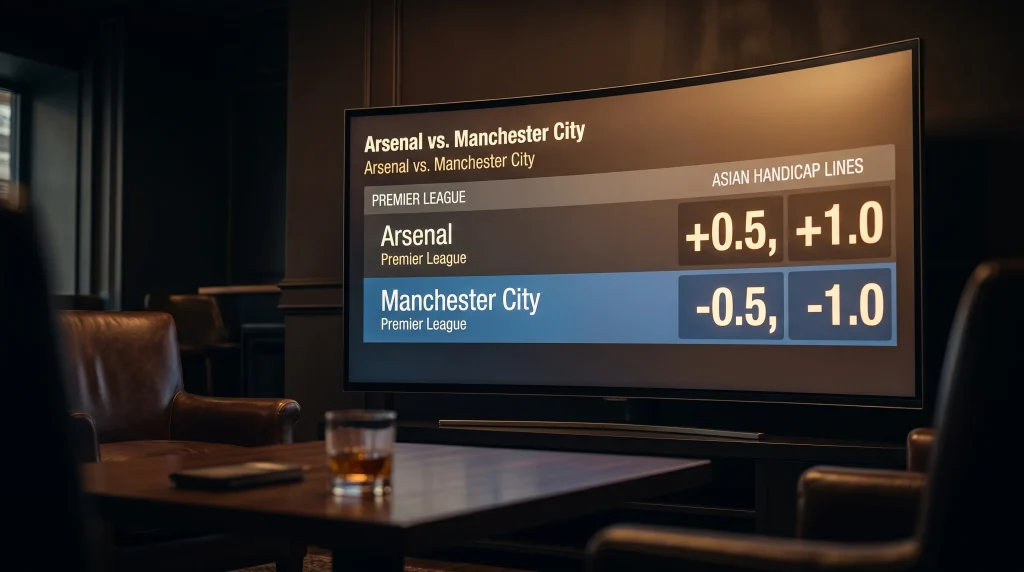
The first time I saw a Premier League heavy favourite priced at 1.20 on the standard match-result market, I instinctively reached for the calculator to work out whether the value was actually there. It wasn’t, of course — the implied probability is over eighty percent, and almost no EPL home favourite actually wins eighty percent of the time. The Asian handicap is what I should have been looking at instead. It exists precisely to solve the problem of short prices on overpriced favourites and to offer a market structure where the bookmaker’s margin is thinner and the punter’s read on a fixture can be expressed more honestly.
UK football remote betting GGY hit £1.3 billion in the year to March 2025, but the share of that on Asian handicap markets is still vastly smaller than match-result and goals markets. The reason isn’t that AH is inferior — it’s that it requires learning, and most casual UK punters don’t put the work in. For anyone analysing English football seriously, AH is one of the cleanest markets available, and it’s worth the learning curve.
What Asian Handicap Removes from the Equation
The standard match-result market has three outcomes — home, draw, away — which gives the bookmaker three positions to price and three margin slots to extract value from. Asian handicap collapses the market into two outcomes by mechanically eliminating the draw. Either the favourite covers the handicap or they don’t. Either the underdog covers the spread or they don’t. The draw, as a betting outcome, ceases to exist in this market structure.

Eliminating the draw does two things. First, it reduces the bookmaker’s combined hold dramatically — typical AH margins sit around two to three percent versus five to eight percent on 1X2 in EPL. Second, it forces the bookmaker to express their view on the favourite’s superiority numerically rather than just probabilistically. A team priced at -1 AH is, in the bookmaker’s view, expected to win by more than one goal more often than not. A team priced at -0.5 AH is expected to win, period, in more cases than they don’t.
For the punter, this means AH is fundamentally a market about how much you think the favourite will win by, not just whether they’ll win. That’s a sharper question to ask, and it’s a question where careful analysis can pay off more reliably than guessing among three outcomes.
The other thing AH removes is the all-or-nothing settlement on near misses. A 0-0 EPL match where you backed the favourite at -0.5 loses cleanly — you needed the favourite to actually win. A 1-1 draw on a -0.25 AH (a quarter line) returns half your stake and loses half — a much softer outcome that reflects the partial truth of “the favourite drew rather than lost”. This partial-settlement feature is the killer app of quarter-line AH, and it’s why serious punters spend so much time on it.
Whole, Half, and Quarter Lines Explained
AH lines come in three families. Whole lines (-1, -2, +1, +2) settle straightforwardly — apply the handicap to the actual score and the team with more “adjusted” goals wins the bet. Exact ties on adjusted score return the stake (a “push”), which is the AH equivalent of a void.

Half lines (-0.5, -1.5, +0.5, +1.5) eliminate the push possibility because the half-goal handicap means the adjusted score can never be tied. A -0.5 favourite needs to win by at least one. A -1.5 favourite needs to win by at least two. Half lines are the cleanest version of AH for beginners because every match resolves to a clear win or loss with no partial outcomes.
Quarter lines (-0.25, -0.75, -1.25, -1.75) are where things get clever. A quarter line is actually a split bet — half your stake goes on the whole line above, half on the half line above. A -0.25 AH is half on level (whole 0) and half on -0.5. If the match ends in a draw, the level half pushes (stake refunded) and the -0.5 half loses, so you get half your stake back and lose half. If the favourite wins by one, both halves of the bet win — you get the level half win plus the -0.5 half win, a clean full-stake profit.
The quarter-line system lets the bookmaker price favouritism in finer increments than half-goal precision allows. The market can express a view like “this favourite is more than a coin-flip but less than a confident -0.5 winner” — that’s the -0.25 line. Or “this favourite is heavily fancied but the -1 might be a stretch” — that’s the -0.75 line.
Settling Quarter Lines Step by Step
The settlement math on quarter lines is the single concept that scares most punters off AH. Once you’ve worked through it twice, it becomes second nature. The mechanic is just two parallel bets being settled independently and combined.
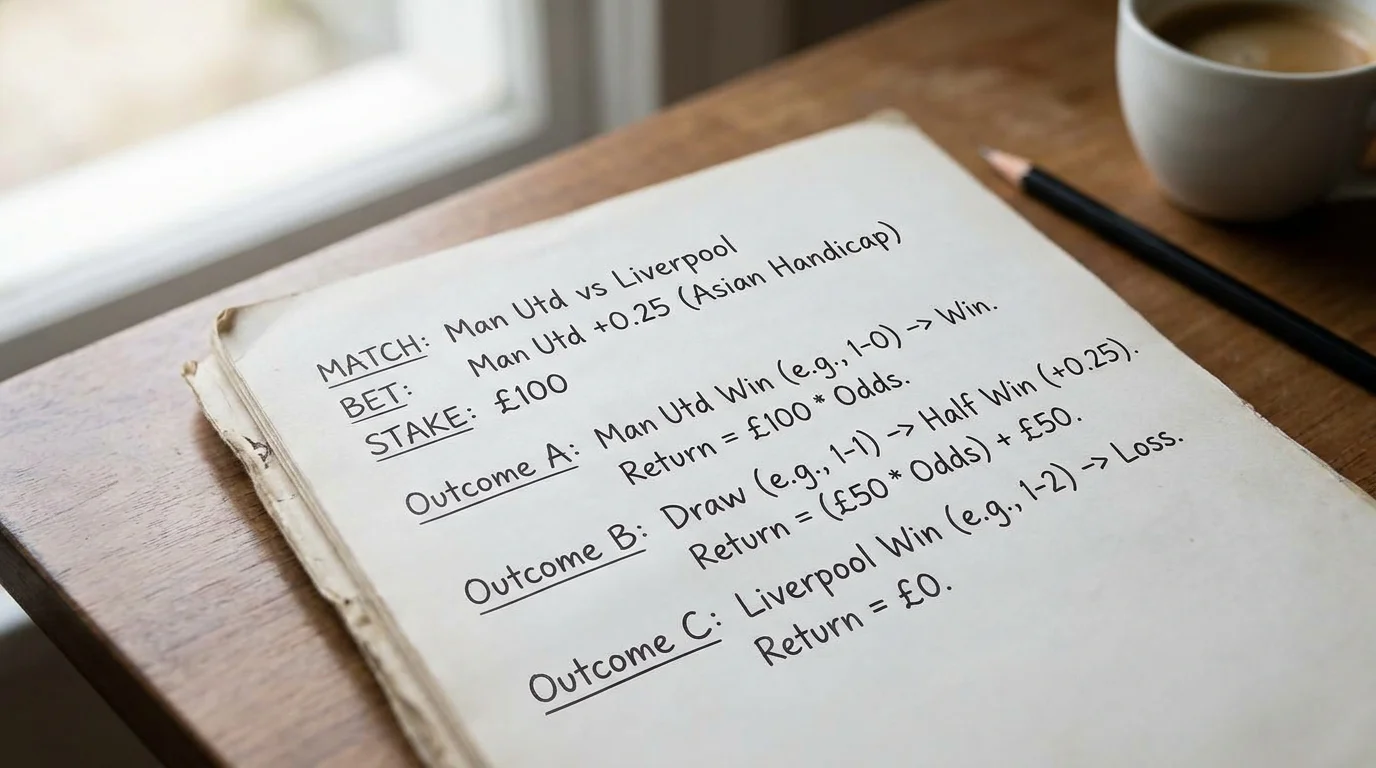
Take a £10 stake on Arsenal -0.75 at 1.90, with Arsenal hosting a lower-half EPL side. The bet is mechanically £5 at Arsenal -0.5 and £5 at Arsenal -1, both at 1.90. If Arsenal win 1-0: the -0.5 half wins (£5 returns £9.50 — profit £4.50), the -1 half pushes because the adjusted score is exactly tied (the £5 stake comes back). Total return on the £10 stake: £14.50. Profit: £4.50.
If Arsenal win 2-0: both halves win cleanly. Total return: £19.00. Profit: £9.00 — exactly what you’d get on a clean -0.75 win at the full quoted price.
If Arsenal draw 1-1: the -0.5 half loses (£5 gone), the -1 half loses (£5 gone). Total return: zero. Loss: £10.
If Arsenal lose 0-1: both halves lose. Total return: zero.
The interesting case is the soft loss. If Arsenal win 1-0, you don’t get the full win you’d have wanted — you get a partial win that reflects the partial truth of the result. That partial settlement is what makes quarter-line AH softer than straight 1X2 and is the reason it attracts professional money disproportionately. The risk profile is asymmetric in the punter’s favour on close results.
When to Prefer Asian Handicap Over 1X2
The clearest case for choosing AH over 1X2 is when you have a strong view on whether the favourite will dominate but a weaker view on whether they’ll actually win. EPL fixtures where a top-six side is hosting a lower-half side but the favourite has been finishing matches conservatively — winning 1-0 rather than 3-0 — are exactly the situations where -0.5 or -0.75 AH outperforms backing the same favourite at short 1X2 odds.

The case is also strong on midweek Champions League ties where Premier League sides face technically inferior continental opposition but rotate heavily. The standard 1X2 prices the rotation risk into a longer favourite line, but the AH market sometimes prices the same scenario more conservatively, leaving small but real value on the heavier handicap for the team that’s still likely to win even with rotation.
The reverse case — when AH is worse than 1X2 — is on coin-flip fixtures where there’s no clear favourite. AH on level (-0/+0) or quarter-line setups like -0.25/+0.25 in even matches strips out the draw and forces a binary outcome, but the underlying uncertainty doesn’t change. The market on these is so tight that the edge from market structure disappears. On true coin-flips, the draw market itself can sometimes be the value play.
The bookmaker’s margin advantage on AH versus 1X2 is significant enough that, even when you’re on the wrong side of the value question, you’re losing less than you would have on the same view expressed in 1X2 form. The structural margin advantage compounds over time, which is why long-term AH bettors tend to outperform long-term 1X2 bettors holding everything else constant.
Reading Asian Line Movement
The AH market is where sharp money lives in football, and the line moves accordingly. Pre-match line movement on AH is one of the cleanest signals about where informed money is going, and watching the line as the week progresses can tell you more about a fixture’s true probability than studying form charts ever will.

The pattern to look for: an AH line that opens at, say, -0.75 on Tuesday morning and steadily drifts toward -1 by Friday evening. That drift means money has come in on the favourite, the market has shifted the handicap to compensate, and the new line reflects an updated read. If the drift continues even after a few prices in your direction, you’re seeing sharp money agreeing with the favourite.
The reverse drift — a line drifting from -1 down to -0.75 — means the underdog has attracted money. Sometimes that’s because of specific information (an injury, weather, team-news), sometimes it’s because the opening line was too aggressive and the market is correcting. Either way, the direction of drift is information.
Watching multiple operators simultaneously is critical because each operator’s line reflects their own customer mix. If most operators are at -0.75 but one is offering -0.5 as a sharp shop’s main line, that one operator’s line is closer to the genuine market consensus and you should use it as your reference point rather than averaging across all operators.
For the related question of how this market interacts with single-player markets where the favourite’s most dangerous goalscorer matters as much as the team result, the analysis is in the piece on the first goalscorer market.
