
Bankroll Management for Football Betting: The Discipline That Decides Long-Term Outcomes
 Available in US
The single most predictable failure mode I’ve watched UK football bettors run into isn’t bad analysis — it’s good analysis ruined by bad sizing. A bettor with a genuine three-percent edge on EPL goal-totals markets can lose their entire bankroll inside a season if their stake sizing doesn’t respect the variance of football betting. Around 290 million online bets a month run through UK operators, and the punters who survive multiple seasons share one trait above all others: they’ve thought seriously about how much to stake before they’ve thought seriously about what to stake on.
This is the article I wish someone had handed me when I started. The math isn’t complicated. The discipline is brutal. Most bettors learn this the expensive way; some don’t learn it at all.
What a Bankroll Actually Is
A bankroll is the total amount of money you’ve allocated to football betting, treated as separate from your living expenses, savings, and any other financial obligations. It’s the working capital of your betting activity. If it goes to zero, your betting activity stops — there’s no top-up from rent money, no overdraft to keep things going, no extending the line of credit.

The mental separation is what makes the math work. If you think of your betting funds as part of your general money, every losing run feels like real financial loss and pushes you toward chasing bets to recover. If you think of your betting funds as a discrete pool with a known size, the losing runs are absorbed within that pool and don’t bleed into the rest of your life.
The bankroll has to be money you can afford to lose entirely. Not “afford to lose but would prefer not to”. Entirely. If the prospect of the bankroll going to zero would cause meaningful financial stress — affecting rent, bills, family obligations — the bankroll is too large for your circumstances. Resize it downward until the worst-case outcome is uncomfortable but survivable.
The other thing the bankroll has to be is genuinely separated. A separate bank account, a dedicated wallet on the operator, or a tracked notional balance you maintain in a spreadsheet. The exact mechanism doesn’t matter; what matters is that you can compute, at any time, how much of your betting capital is currently in play and how much remains.
Stake Sizing as a Percentage
The cleanest way to size bets is as a percentage of the current bankroll. A stake of one to two percent per bet is conservative and appropriate for most football betting strategies. A stake of three to five percent is aggressive and only appropriate for genuinely high-edge bets where you have strong analytical confidence.

The math behind percentage staking works like this. If your bankroll is £1,000 and your stake is two percent (£20), a losing run of ten bets in a row leaves you at roughly £820 — down eighteen percent. The same losing run at five percent stakes leaves you at around £600 — down forty percent. The compounding of percentage staking over losing runs is non-linear, and the difference between conservative and aggressive sizing is enormous over realistic football-betting variance.
The variance of football betting is high enough that ten-bet losing runs are routine even with genuine three to five percent edge. A bettor running a fifty-five percent strike rate at even money — a meaningful edge — still loses ten in a row roughly once every couple of hundred bets. Plan for these runs. Size for these runs. Don’t be surprised when they happen.
The Kelly Criterion is the formal mathematical answer to optimal staking — stake a fraction of bankroll equal to your edge divided by the odds available. In practice, full-Kelly staking is too aggressive for almost all real-world betting because your edge estimates are noisier than the math assumes. Half-Kelly or quarter-Kelly is the conservative implementation that most professional bettors actually use. The practical takeaway: size below what your math says is optimal, because your math is more uncertain than it feels.
Variance and Why It Hurts More Than You Expect
Variance in football betting is structurally large. A bet at 2.00 with an edge of five percent has a positive expected value, but the variance of individual outcomes is huge — half the time you lose the stake, half the time you win the stake. The realised yield over a hundred bets at this edge has a standard deviation that swamps the expected return.

The specific number that matters: across a hundred bets at 2.00 with a true win probability of 52.5% (five percent edge), the expected yield is five percent of total turnover, but the realised yield ranges roughly between minus five percent and plus fifteen percent across reasonable variance. A four-hundred-bet sample tightens that range substantially, but still leaves enough variance that distinguishing genuine edge from random noise requires care.
The implication for bankroll management is that you need enough bankroll to survive the unlucky tail of variance, even if your edge is real. A bankroll of fifty stakes (i.e., one stake equals two percent of bankroll) survives most reasonable variance runs. A bankroll of twenty stakes (five percent per stake) does not survive the worse runs and produces bust scenarios on bettors with genuine edge.
The other variance factor most punters underestimate is correlation. If your weekend betting plan involves multiple positions that are all correlated — backing three EPL favourites on the same weekend, for example — your actual variance is higher than the per-bet variance suggests. The bets aren’t independent in expected value terms, but they are independent in psychological impact, and a bad weekend on correlated bets can produce drawdowns that the per-bet variance math wouldn’t have predicted.
Tracking Every Bet
The discipline that turns bankroll management from theory into practice is tracking. Every bet placed, every outcome settled, every stake size, every price taken. The tracker doesn’t need to be sophisticated — a spreadsheet with date, fixture, market, selection, price, stake, result, and running bankroll is sufficient.
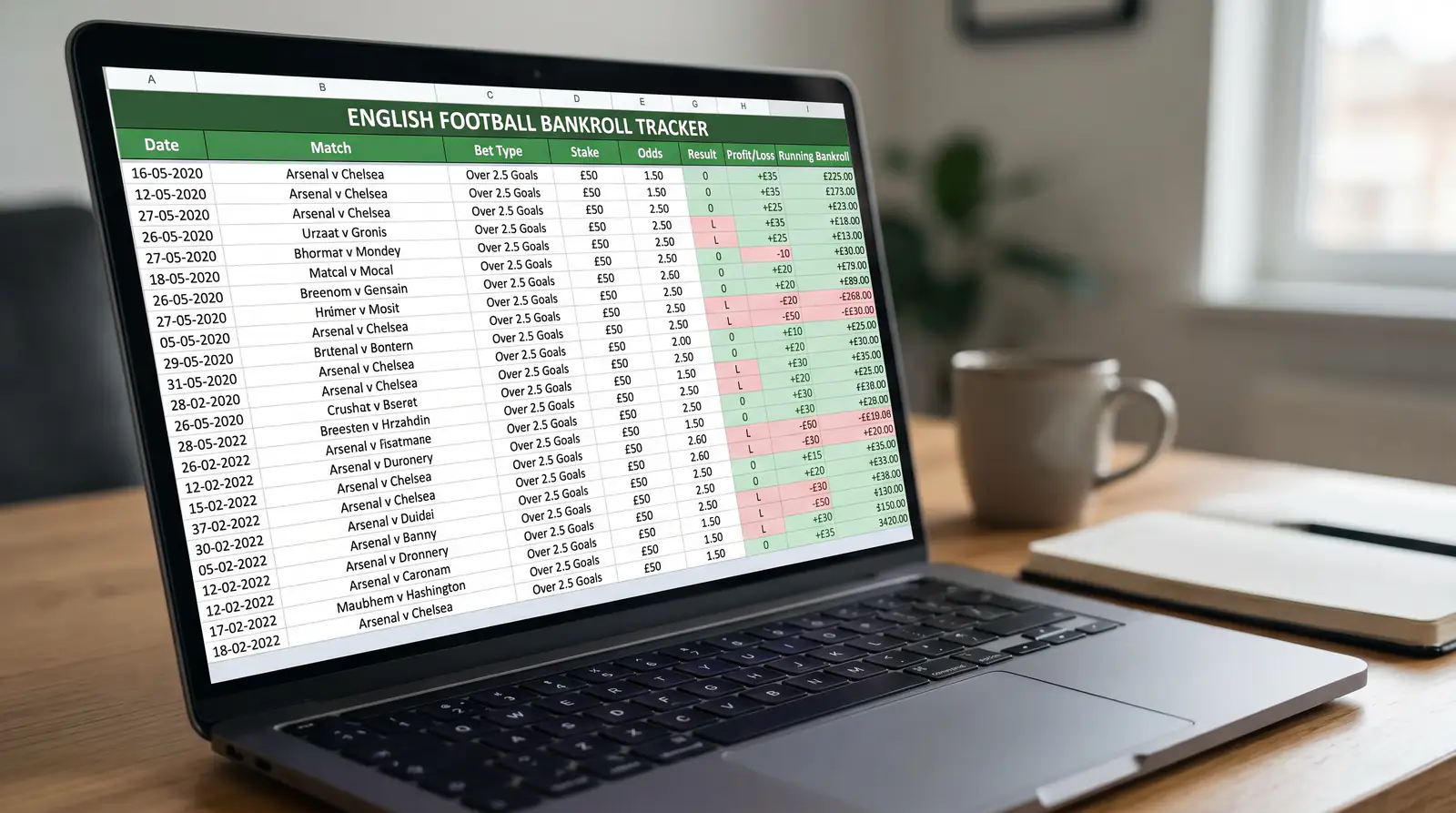
The tracker tells you things you cannot otherwise know. It tells you your true strike rate by market type. It tells you whether your edge is real or whether your wins have been variance against an underlying losing position. It tells you which months, which competitions, and which market types you actually profit on. Most bettors who start tracking are surprised by what the data reveals — usually unflattering surprises that prompt strategy changes.
The most important number on the tracker is the running yield — total profit divided by total turnover. A positive yield over a meaningful sample (say, three hundred bets minimum) suggests genuine edge. A negative yield over the same sample suggests the edge isn’t there, regardless of how good individual bets feel. Trust the data over the feeling.
The second most important number is the maximum drawdown — the largest percentage decline from peak bankroll to subsequent low. The drawdown number tells you how brutal your variance has been and how close you came to bust. If the maximum drawdown across a season exceeds forty percent, your stake sizing was too aggressive for your edge regardless of whether you finished the season positive.
The Emotional Discipline of Drawdowns
The math of bankroll management is the easy part. The hard part is staying disciplined during the inevitable drawdowns. Every football bettor — even the most successful — experiences periods where the bets just don’t land. Two months of negative yield isn’t unusual. Three months is uncommon but happens. Anything beyond that is rare but possible for bettors who are genuinely beating the market.

The emotional response to drawdown is universally to increase stake sizes to “win back” what’s been lost. This is the single most expensive psychological mistake in betting and it kills more bankrolls than any analytical error. The math says the opposite: when your bankroll has shrunk, your stake size as a percentage shrinks proportionally to protect the remaining capital, and the absolute stakes get smaller, not larger.
The discipline tool I rely on most is pre-commitment. Before the season starts, write down your stake-sizing rules. Two percent per bet, no exceptions. If you find yourself wanting to go to three percent because of a particularly strong read, the rule trumps the impulse. If you find yourself wanting to go to four percent because of a recent losing streak, the rule trumps the impulse with even more authority.
The other discipline tool is bet-volume capping. Set a maximum number of bets per week, per month, or per fixture window. Variance compounds with bet count — the more bets you place, the more your realised yield disperses from your expected yield. Keeping bet count under control is one of the structural protections against runaway variance.
Resizing for Bankroll Changes
Bankroll management is dynamic, not static. As your bankroll grows or shrinks, your stake size in absolute terms changes proportionally. A two percent stake on a £1,000 bankroll is £20; the same two percent on a £1,500 bankroll is £30. The absolute stake follows the bankroll size, not the previous fixed stake.

The resizing should happen at regular intervals rather than continuously. Recomputing stake size after every bet creates a noisy signal that doesn’t reflect underlying edge changes. Recomputing weekly or monthly produces a smoother adjustment that reflects sustained bankroll movement.
The other resizing consideration is withdrawal discipline. If your bankroll grows substantially over a season, the temptation is to leave the growth in the betting account and use it to stake larger. The professional discipline is to withdraw a portion of profits periodically — locking in some of the gain as actual realised income rather than as betting capital. The exact withdrawal rate depends on your risk tolerance and financial situation, but the principle is that not all profits should be reinvested as larger stakes.
For the related question of how the broader responsible-gambling toolkit — deposit limits, time-outs, the regulatory environment — fits alongside the personal discipline of bankroll management, see the piece on responsible gambling tools in the UK.
