
Promotion Odds in the Championship: Pricing the Path to the Premier League
 Available in US
The Championship is the most lucrative second-tier in world football and pricing promotion from it correctly is one of the longest-running puzzles I work on each season. The first-season Premier League prize for the play-off winner sits at a minimum of £205 million in immediate revenue. Across all three promotion slots the cumulative financial reward is somewhere north of £1 billion in compound value over a three-year period if all three clubs avoid immediate relegation. That weight of money shapes everything — squad construction, manager tenure, tactical risk-taking — and it shapes the betting market in patterns that recur year after year.
What follows is the framework I use to think about Championship promotion betting across the full season cycle. It isn’t the framework for a single match; it’s the strategic map for the whole campaign.
The Three Routes Up and How They’re Priced
Promotion from the Championship happens via three routes — first place, second place, or via the four-team play-off. The first two are automatic; the third requires winning a two-leg semi-final and a one-off final at Wembley. The bookmaker prices the routes separately as well as combining them into a single “to be promoted” market.
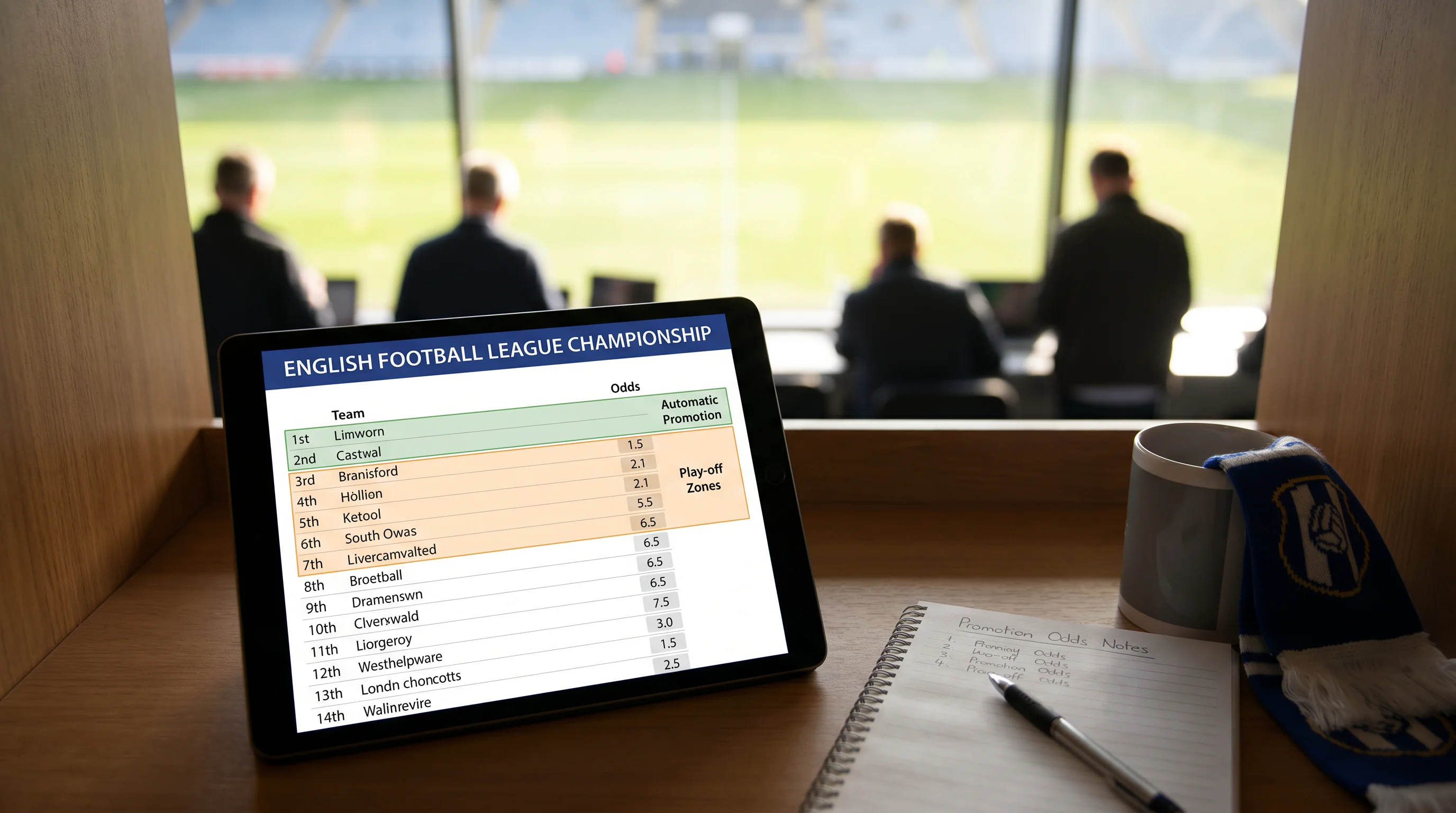
The mathematical reality of the third route is unforgiving. Across the past ten Championship seasons, only three of the clubs that entered the play-offs from the third position made it through to the Premier League — a strike rate of thirty percent. From the lower play-off positions (fourth, fifth, sixth) the strike rate drops further. A club priced at 2.50 to win promotion from a third-place position has implied probability around forty percent, which is a sharp gap above the historical thirty-percent rate.
This means the play-off-route promotion markets are systematically tighter than the underlying probability supports for most contenders. A club priced at 2.00 to win promotion via the play-offs implies fifty percent — that’s a price the market only justifies for genuinely dominant teams that finished third because of a late-season collapse, not the typical play-off entrant.
The automatic-promotion markets are priced more sharply because the season-long table tends to converge on a more predictable outcome. The two automatic spots typically go to teams that have been in the top three or four for most of the season, and the bookmaker’s pricing of these positions improves substantially as the season unfolds. The window for value on automatic-promotion markets is in the first half of the season, before the top two have separated themselves; after Christmas, the prices are usually too tight to be interesting.
Parachute-Payment Favourites and Their Pricing Premium
Twelve Championship clubs collectively pumped £554 million of owner equity into the second tier in the 2023/24 season, with the top three contributing about seventy percent of that. Owner cash and parachute payments combine to create a financial pecking order within the Championship that the betting market reflects in promotion pricing.

Parachute-payment clubs — sides relegated from the Premier League in the previous one to three seasons — are typically priced as promotion favourites in August on the strength of their squad budgets. The pricing premium relative to non-parachute sides is usually substantial. A first-year parachute club might be priced at 3.50 to win promotion, while a non-parachute club with comparable squad quality might be priced at 6.00 to 8.00.
The historical hit rate of parachute-payment favourites is decent but not spectacular. Roughly half of first-year parachute clubs win promotion; the rate drops to around thirty percent for second-year parachute clubs as squad quality erodes and motivation diminishes; by year three, the rate is comparable to non-parachute sides. The pricing doesn’t always reflect this decay — second-year parachute clubs sometimes still trade at first-year-style premium prices when the underlying probability has dropped considerably.
The trade against the parachute favourite is the second-year price specifically. If a second-year parachute club is priced at 3.50 to win promotion, you’re essentially betting against a thirty-percent hit rate at implied 28.6 percent — there isn’t much edge there unless you have specific reasons to think this particular second-year club is below the average trajectory.
The opposite trade — backing a non-parachute club with strong underlying numbers at a long price — is interesting when the financial pecking order obscures genuine tactical quality. A well-coached side with smart recruitment in the £15-20 million squad-budget range, priced at 8.00 or 10.00 for promotion, can genuinely have a fifteen-percent probability of going up — which is positive expected value at those prices.
Early-Season Pricing Errors
The August opening market on Championship promotion is constructed primarily from squad budgets, parachute status, and managerial reputations. The bookmaker has no current-season data to work from, so the model defaults to last-season information and pre-season transfer activity.
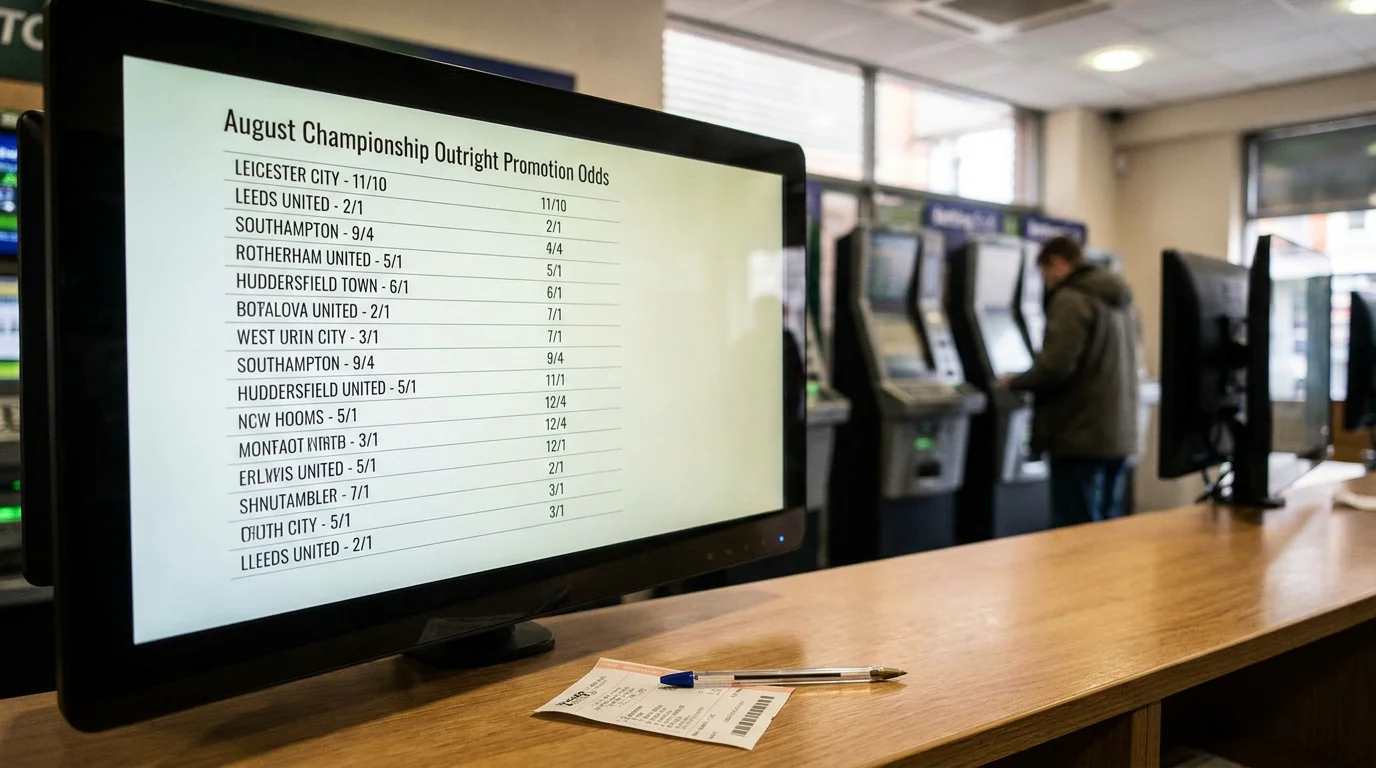
The pricing errors that recur every August: clubs that overhauled their squads heavily in the summer are priced based on the previous squad’s results, not the new one. Clubs that lost their best players to Premier League transfers are priced on continuity assumptions that ignore the actual departures. Clubs that appointed new managers in the summer are priced on the previous manager’s tactical setup, even when the new manager will play a completely different style.
These pricing errors typically take six to eight matches to clear from the market. By September or early October, the bookmaker has enough current-season data to reprice, and the inefficiencies that existed in August have mostly disappeared. The window between August and the international break in early September is when long-term promotion outright value is most consistently available.
The specific bets that work in this window are usually for clubs that the market has under-rated relative to their squad strength. A side that finished tenth last season but added two key signings and a tactically progressive manager might be priced at 15.00 in August, when their actual probability of finishing top six is closer to thirty percent. That price doesn’t last past the first international break; the market corrects fast once the actual football reveals the underlying improvement.
Each-Way Betting on Promotion
The each-way market on Championship promotion lets you back a club to either win promotion outright or finish in the play-off positions (fourth, fifth, or sixth), with the place portion typically settling at one-quarter of the win odds. This is the betting structure where most genuine long-term value lives, because the conditional payout structure rewards the “almost there” scenarios that long-shot outright bets don’t capture.

The math works in the punter’s favour when a club’s probability of finishing in the top six is significantly higher than the implied probability of the win price. A 20.00 each-way punt with 1/4 odds for the first three places effectively pays out at 5.00 for the place portion alone — that’s an implied twenty percent for “top three or play-offs”, which is often well below the actual probability for capable mid-table clubs.
The clubs to look at for each-way value are typically the well-coached non-parachute sides priced between 12.00 and 30.00 in the autumn outright markets. Their probability of winning promotion outright might be small, but their probability of squeezing into the top six is meaningfully higher — and the each-way structure captures most of that probability for partial payout.
The risk with each-way is that the place portion settles in cash but at relatively short prices once converted. You’re trading away some headline payout for greater hit-rate, which is the right trade for most punters managing variance across a season.
Hedging as the Season Closes
Late-season Championship promotion betting often involves managing existing positions rather than entering new ones. If you backed a club at long prices in August and they’re now in the play-off positions, the question becomes whether to lay off some of the exposure to lock in profit, or to let the position run to settlement.
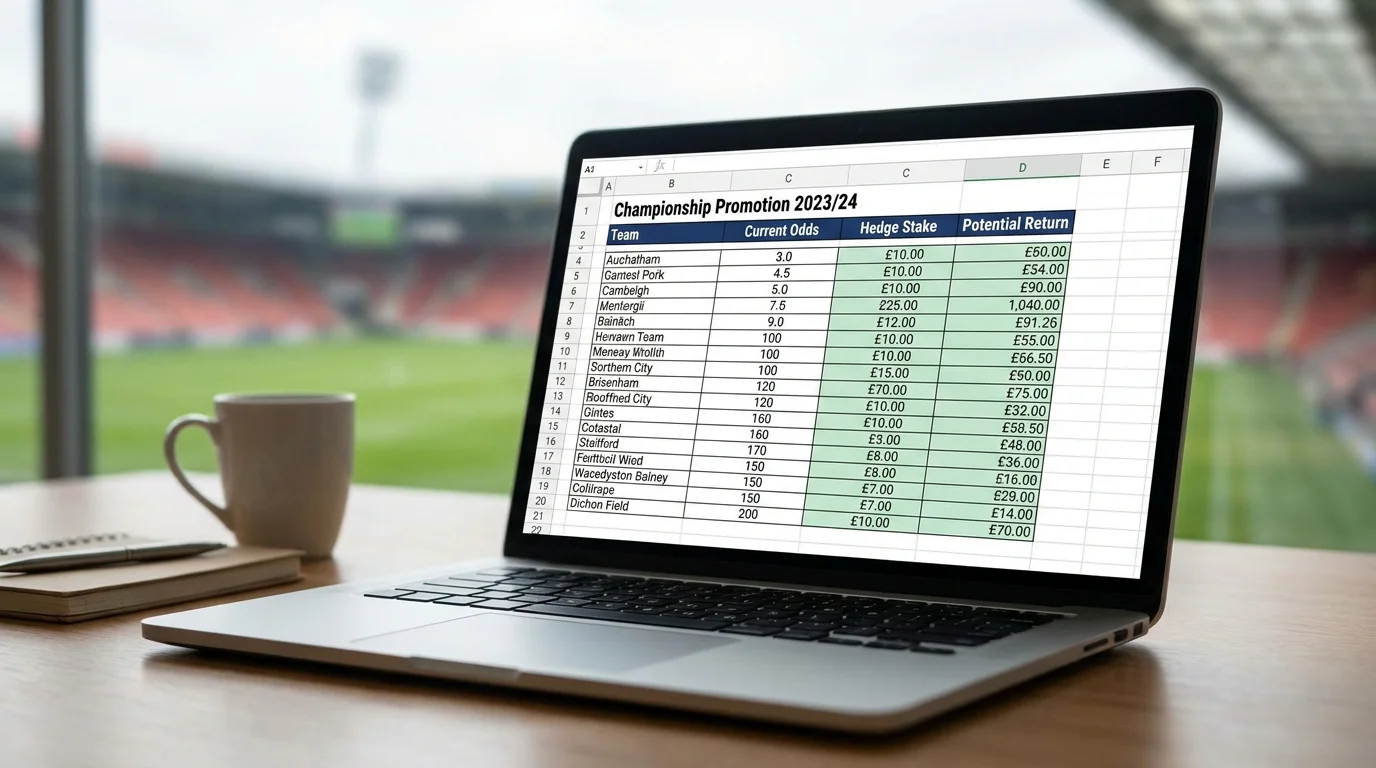
The play-off-route hit rate of thirty percent is the relevant number here. If your original 15.00 outright is now trading at 5.00 in March because your club is on track to enter the play-offs from third or fourth, the math of holding versus laying-off is hard. Holding gives you a thirty-percent chance of the full 15.00 payout. Laying off some portion at 5.00 locks in a smaller but certain profit on that portion. The right answer depends on your risk tolerance and your bankroll, not on any universal formula.
The hedge that almost always makes sense is on the play-off final itself. If your club has reached Wembley, the binary nature of the final means you’re now exposed to a coin-flip rather than to a probabilistic distribution. Backing the opposition at the final-day match-result market — at whatever fair price the operator offers — converts the binary win-or-lose into a partial profit either way. The “win some, win less” outcome from a successful hedge often produces a less anxious final-day experience than the full unhedged exposure.
For the equivalent strategic question at the opposite end of the Championship table, where late-season relegation pricing creates its own set of value windows, see the analysis in the piece on relegation battle betting.
